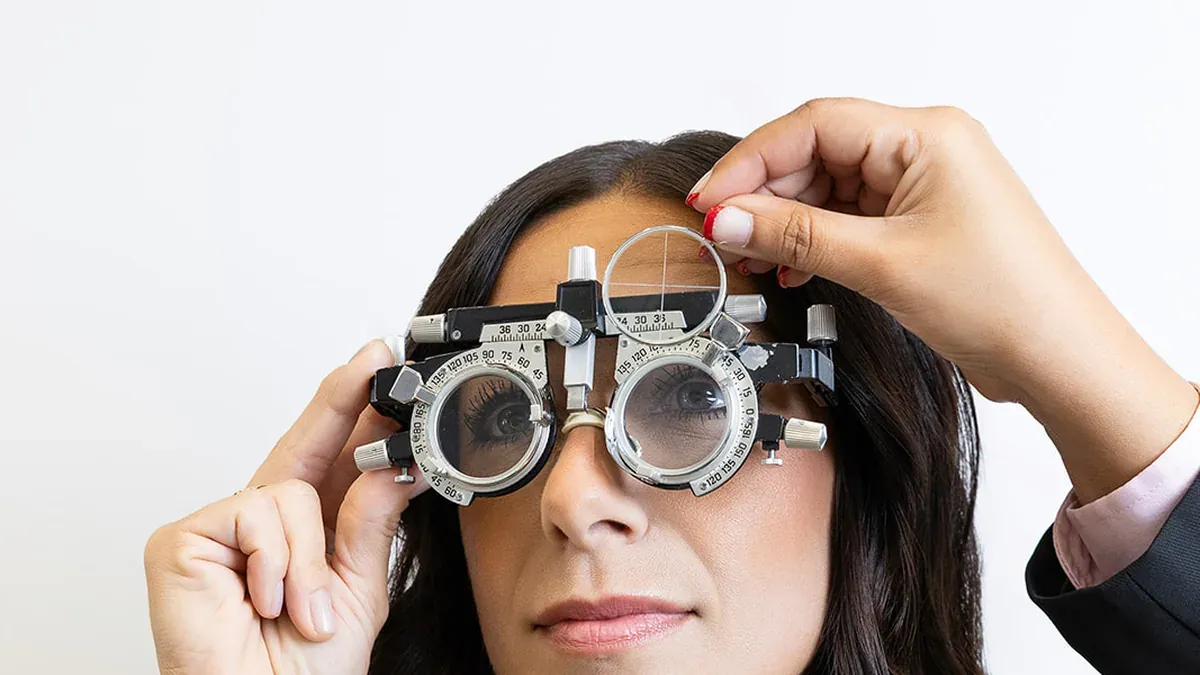
The CDL eye exam is the vision screening component of the DOT physical, required for anyone obtaining or renewing a commercial driver's license. The Federal Motor Carrier Safety Administration sets three baseline standards: at least 20/40 visual acuity in each eye, a minimum horizontal peripheral field of 70 degrees per eye, and reliable color recognition for traffic signals. Corrective lenses count. A driver who wears glasses or contacts and meets those thresholds qualifies under the same rules as a driver with uncorrected vision. If you need to book a commercial driver vision test in New York, OPTYX optometrists provide a certified eye exam and documentation across 13 locations serving Manhattan, Long Island, the North Fork, the Hamptons, and Westchester.
Who Needs a CDL Eye Exam?
This screening is required for any driver obtaining or renewing a commercial driver's license. Semi-trucks, buses, tractor-trailers, and other large commercial vehicles are all covered. The exam does not happen once; it repeats at every DOT medical certification renewal, so vision is re-evaluated throughout a driver's career.
DOT physical vision requirements under FMCSA rules apply to interstate commercial drivers. Most states mirror these federal thresholds in their own commercial licensing programs, so the standards are consistent across the country for anyone who needs a CDL. If a driver is unsure which standards apply to their specific license class or operation type, the certifying medical examiner can clarify before the examination begins.
Vision changes between certification cycles. A driver who passed comfortably at the previous renewal may find that the same correction no longer supports the required standard if the prescription has drifted or an underlying condition has developed in the meantime. That is precisely why each renewal requires a fresh CDL eye exam rather than relying on past results.
What Vision Is Required for a CDL?

The 20/40 vision CDL requirement applies to each eye tested individually. A driver who sees 20/15 in the right eye but only 20/80 in the left does not meet the standard. Each eye must reach 20/40 on its own, with or without correction.
The full set of DOT physical vision requirements covers three components:
| Component | Minimum Standard |
|---|---|
| Visual acuity, each eye | 20/40 (with or without correction) |
| Peripheral vision, each eye | Minimum 70 degrees horizontal |
| Color recognition | Distinguish red, green, and amber signals |
| Binocular acuity (both eyes together) | 20/40 or better |
The 20/40 threshold means a driver sees at 20 feet what a person with standard vision sees at 40 feet. At highway speeds, the difference between 20/40 and marginal acuity compresses the available reaction window in ways that matter behind a vehicle that may weigh 40 tons. The 70-degree peripheral standard reflects the lane changes, merge angles, and shoulder scanning that commercial operators do continuously. These are the thresholds a certified medical examiner checks during this exam before signing the DOT medical certificate.
What the CDL Eye Exam Tests
The vision portion of the DOT physical breaks into three separate tests. Each measures a distinct function, and each is evaluated independently. Failing any single component means the driver does not pass the commercial driver vision test, regardless of how they perform on the other two. Understanding what each step involves in the CDL eye exam reduces uncertainty and helps drivers prepare.
Visual Acuity and the DOT Eye Chart
The acuity portion uses a standardized Snellen chart, the same DOT eye chart used in most routine screenings. Rows of letters decrease in size from top to bottom. The driver reads aloud from a fixed 20-foot distance, with each eye tested separately before both are tested together.
The examiner records whether corrective lenses were worn. What the driver wears during the CDL eye test should be exactly what they wear while driving, not a backup pair or a recently acquired prescription that hasn't been adjusted to yet. If a corrective-lens restriction is already on the CDL, that restriction requires the driver to wear correction at the exam.
The acuity result determines whether a corrective-lens restriction appears on the DOT medical certificate, which the state licensing agency then uses when issuing the CDL.
Color Recognition
The color recognition portion verifies that a driver can accurately distinguish traffic control colors. It typically involves identifying numbers or shapes embedded within a field of colored dots. The standard is not a scoring percentage; it determines whether the driver can reliably separate red from green and distinguish amber from both under standard examination conditions.
Mild color perception deficiency often goes unnoticed in daily life. This portion of the exam applies a higher standard because commercial stopping distances and traffic density leave narrow margins for delayed signal identification. A driver uncertain about their color vision should request testing at an optometrist before the CDL eye test. More detailed assessment tools are available in an optometric setting than in a typical DOT physical clinic.
Peripheral Vision
The peripheral vision test measures the horizontal field of view in each eye. A minimum of 70 degrees per eye is required. The examiner maps how far outward a driver can detect motion or objects while looking straight ahead.
Near-peripheral vision catches vehicles entering from on-ramps, cyclists at the lane edge, and debris on the shoulder. It is also one of the earliest detectable signs of conditions such as glaucoma, often appearing before central acuity is affected. The CDL eye exam screens only the threshold; a full optometric evaluation maps the entire field. OPTYX conducts visual field testing as part of its comprehensive examination, providing a more complete picture of peripheral function than the DOT screening alone captures.
Can I Drive Commercially with Corrective Lenses?
Yes. The FMCSA permits corrective lenses during the vision screening and while operating a commercial vehicle. Glasses and contact lenses both satisfy the standard equally, with no regulatory preference for one over the other.
When a driver meets the 20/40 vision CDL requirement only with correction, the certified medical examiner marks this on the DOT medical certificate. The state licensing agency adds a restriction code to the CDL, requiring the driver to wear corrective eyewear at all times while operating a commercial vehicle. This restriction applies between renewals as well as on exam day. A driver whose prescription drifts significantly over time and continues driving under the original CDL is out of compliance if their uncorrected acuity has since dropped below 20/40, even if the CDL itself is still valid on paper.
Prescriptions do not stay accurate indefinitely. Near vision tends to shift gradually after age 40 as the natural lens inside the eye becomes less flexible, a process known as presbyopia. A driver who passed the CDL eye test easily three years ago may find that the same correction no longer provides 20/40 acuity today. The guide on age-related near-vision changes covers that progression and explains when a prescription update typically becomes necessary.
OPTYX optometrists assess whether current correction meets the 20/40 standard and issue an updated prescription if not, often combining both in the same appointment.
Can You Pass a DOT Physical with One Eye?

No. Standard FMCSA vision regulations require each eye to independently meet both the 20/40 acuity standard and the 70-degree horizontal peripheral field minimum. A driver who is blind in one eye, or whose one eye fails either threshold, does not satisfy the baseline CDL eye exam requirement.
The FMCSA operates a federal vision exemption program for drivers who do not meet the standard vision thresholds. Some monocular drivers have qualified by demonstrating a defined period of safe driving history. Eligibility, required documentation, and the application process are determined entirely by the FMCSA and fall outside the scope of an eye exam or optometry practice. Drivers in this situation should consult a certified medical examiner and contact the FMCSA directly about the exemption program.
Some states also administer intrastate commercial vehicle permits under state-specific rules that differ from the federal CDL standard. Those rules vary by jurisdiction. No CDL eye exam outcome alone determines whether an exemption or state-level option applies; that pathway is a separate regulatory process requiring direct contact with the FMCSA or the relevant state agency.
What Happens If You Fail a DOT Eye Exam?
Failing the DOT vision screening does not automatically end a driving career. It opens a process of evaluation and correction.
Update the prescription first. An outdated prescription is the most common reason drivers fail the acuity portion of the CDL eye test. Visiting an optometrist, updating glasses or contacts, and allowing adjustment time often resolves the issue. Once the new prescription has stabilized, the driver schedules a new DOT physical.
Rule out underlying conditions. A fail result sometimes points to something beyond lens strength. Dry eye, corneal surface changes, early lens clouding, or elevated intraocular pressure can all reduce functional acuity without obvious day-to-day symptoms. These conditions also cause unexplained discomfort or eye redness that drivers tend to attribute to fatigue. The OPTYX article on when eye redness signals something more covers several of the conditions an optometrist can assess and address.
Consider vision therapy. When the failing component involves peripheral awareness, tracking, or coordination rather than refractive error, vision therapy may help. These are structured programs supervised by an eye care professional that target specific functional deficits identified during examination.
Discuss surgical options. Some drivers with significant refractive error pursue surgical correction as a longer-term solution. That decision requires evaluation by a qualified ophthalmologist. OPTYX does not perform surgery but can document current visual status for a surgical referral.
There is no mandatory waiting period after a CDL eye exam failure. As soon as a driver has addressed the underlying issue, they can schedule a new DOT physical. Acting promptly limits any gap in certification status that could affect employment.
Where Can I Get a CDL Eye Exam in New York?
In New York, this exam must be performed by a certified medical examiner on the FMCSA's National Registry. Optometrists who hold that certification can conduct the vision components of the DOT physical alongside their regular services.
OPTYX optometrists serve commercial drivers across 13 New York locations in Manhattan, Long Island, the North Fork, the Hamptons, and Westchester. A truck driver eye exam New York appointment at OPTYX can be scheduled as a standalone CDL screening or combined with a comprehensive eye exam if a prescription update is also needed. Combining both visits reduces scheduling complexity and allows the optometrist to assess overall eye health alongside the specific DOT physical vision requirements.
What to bring to your CDL eye exam:
- The corrective lenses you wear while driving, not a backup pair
- Any prior DOT medical certificates, if available
- A complete list of current medications (required for the full DOT physical)
- Photo identification
Drivers who also need a standard state vision screening for a non-commercial license can find specific guidance in the DMV eye exam guide for New York drivers. The state standard and the FMCSA standard both assess visual acuity, but only the DOT physical version satisfies commercial licensing requirements.
Staying Current Between CDL Renewals

The vision screening repeats at every DOT physical renewal cycle. Letting vision drift between certifications and discovering the problem at the exam creates avoidable delays in an active driving career.
Changes that most commonly cause drivers to fail a renewal exam include:
- Prescription drift, particularly in near and intermediate vision after age 40
- Increased sensitivity to glare or reduced contrast at night, often an early sign of lens changes
- Early peripheral field reduction that does not register in daily life but falls below the 70-degree standard
None of these develop overnight. Each is detectable during a comprehensive eye exam well before it affects the CDL eye test result.
Scheduling a comprehensive exam in the year before each DOT physical renewal gives an optometrist time to identify any changes and update the prescription while there is still time to adjust to new lenses. Walking into the CDL eye exam with a current, well-fitted prescription removes most common fail risks before the exam even begins. For drivers concerned about whether contact lens wear during long shifts or extended screen time between routes is contributing to dry eye or vision changes, an OPTYX optometrist can evaluate all of those factors in a single comprehensive visit.
Book an Eye Exam
If a CDL renewal is approaching or your prescription has not been reviewed in over a year, Book an Eye Exam at OPTYX to get a full optometric evaluation before the DOT physical.