Nearsightedness causes fall into two broad categories: inherited eye shape and how those eyes are used over time. If one or both parents are myopic, a child carries meaningfully higher risk. But genes do not tell the whole story. A comprehensive eye exam is the only reliable way to measure what is happening inside the eye, track changes year to year, and determine whether any intervention is warranted.
The Main Myopia Risk Factors at a Glance

| Risk Factor | Type | Modifiable? |
|---|---|---|
| One myopic parent | Genetic | No |
| Two myopic parents | Genetic | No |
| Extended near work and screen time | Behavioral | Yes |
| Limited time outdoors in natural light | Environmental | Yes |
| Rapid growth during childhood | Biological | No |
| High academic-pressure environments | Environmental | Partly |
A 2026 review in Optometry and Vision Science notes that environmental and behavioral factors, including near work, screen time, and outdoor activity, are "increasingly recognized as modifiable contributors" to myopia, offering real promise for prevention (Ostrin, 2026).
Is Nearsightedness Genetic?
Genetics are among the leading nearsightedness causes worldwide. Having one myopic parent raises a child's risk considerably. Having two raises it further.
Researchers have been narrowing down the specific variants involved. A 2023 whole-exome sequencing study of 19,219 Han Chinese individuals identified three newly associated genetic loci for high myopia, including an East Asian ancestry-specific variant in the FKBP5 promoter (Su et al., 2023). That finding helps explain why myopia rates vary so sharply between populations, while confirming that genetics and myopia are tightly connected without being the sole determinant.
Genes load the odds. Environment decides whether myopia actually develops.
What Causes Nearsightedness in Children?

Myopia in children most often develops when the eyeball grows slightly too long from front to back, or when the cornea curves more steeply than typical. Light entering the eye then focuses in front of the retina rather than directly on it. Distant objects look blurry. Close ones stay sharp.
This structural change happens mainly during the school years and typically stabilizes around age 20. Children with a genetic tendency toward myopia are more likely to develop it when near work fills most of their day and outdoor time is limited.
East Asian populations show some of the highest myopia rates globally. A 2024 paper in the Journal of Public Health Policy argues that Confucian educational culture, with its intense academic pressure from an early age, drives the sustained near work and reduced outdoor time that have fueled the region's myopia epidemic (Yii, 2024). In parts of East Asia, over 80% of young adults are myopic.
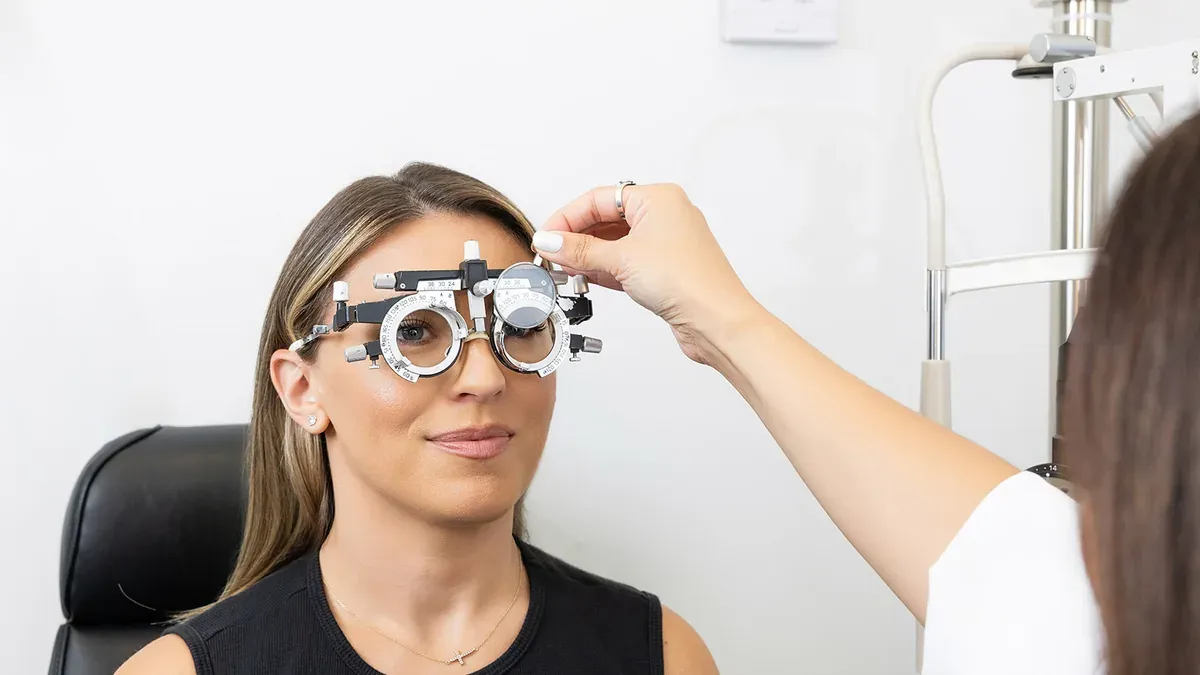
A child squinting at the classroom board, sitting unusually close to the screen, or rubbing their eyes after reading deserves a proper myopia eye exam rather than a brief school screening. The optometrists at OPTYX New York see pediatric patients across Manhattan, Long Island, the North Fork, the Hamptons, and Westchester.
Can Reading Cause Nearsightedness?
Reading alone does not cause myopia. Sustained near work, however, does appear to accelerate its development in children already predisposed by genetics.
The eye's lens stays tightly engaged during close work. When that continues for hours at a stretch, the sustained focusing demand may generate signals that encourage the eyeball to elongate. Over months and years, that pattern can become progressive myopia. Not all nearsightedness causes lead to the same rate of progression, but habitual near work over years adds meaningfully to risk in susceptible individuals.
Screen time raises the same concern. Taken together, these nearsightedness causes share a common thread: sustained close-focus demand with insufficient visual recovery time. The screen itself is not the issue. Duration, viewing distance, and the way screens replace outdoor activity all matter more. For adults whose work is primarily screen-based, understanding how lenses designed for near-screen use differ from general-purpose reading glasses can reduce daily visual fatigue.
What Is False Myopia?
False myopia, also called pseudo-myopia, is a temporary condition in which the eye's focusing muscles lock into near-focus mode after prolonged close work. Distance vision blurs even when the person tries to shift focus to a distant object.
Consider someone who spends long hours at a laptop and notices distant objects looking fuzzier each evening. After a full week away from screens, distance vision returns to normal. That is false myopia.
The condition is usually reversible with adequate rest. Prolonged visual stress without recovery time, however, can lead to lasting structural change. Anyone experiencing unexplained blurry distance vision should get a professional evaluation rather than assuming it will pass on its own.
Can Nearsightedness Be Prevented in Kids?

Full prevention is not always possible when genetics are the primary driver. Slowing progression, however, is achievable, and nearsightedness prevention strategies have improved considerably as the research base has grown. Identifying nearsightedness causes early gives families and clinicians the best opportunity to act before a prescription accelerates.
The most consistently supported environmental approach is outdoor time in natural light. Regular outdoor activity is linked to lower risk of myopia onset and slower progression across multiple studies, making it the most accessible protective behavior for school-age children.
Clinical options also exist. A 2023 systematic review and network meta-analysis covering 80 randomized controlled trials found that several interventions, including orthokeratology, can significantly slow axial elongation in myopic children, with certain combined approaches producing the strongest effects (Zhang et al., 2023). The right option for any individual child depends on the rate of progression and factors an eye care provider evaluates directly.
Parents sometimes wonder whether ordering a stronger lens prescription without a full exam is enough for a growing child. It is not. You can read more about why an accurate prescription for a child's changing vision requires an in-person evaluation before any lens update carries real clinical value.
When Progressive Myopia Becomes High Myopia
Not all nearsightedness stays mild. Progressive myopia describes a pattern where the prescription deepens measurably each year, typically during childhood and adolescence. At its more severe end, high myopia is one of the leading causes of visual impairment and blindness worldwide (Su et al., 2023).
Regular monitoring through an annual exam tracks how fast the prescription is moving and keeps management options open. If a child's prescription changes significantly between visits, that signals a faster progression rate and warrants a direct conversation at the next appointment, not the one after.
For adults managing myopia across decades, consistent eye health monitoring stays important. Understanding when glaucoma typically starts and the key risk factors by age helps frame why annual exams remain worthwhile even once a prescription appears stable.
Book an Eye Exam
If distance vision is blurring or a prescription keeps changing, bring those concerns to an optometrist. Book an Eye Exam at your nearest OPTYX location.
Sources
- Su J et al. (2023). Sequencing of 19,219 exomes identifies a low-frequency variant in FKBP5 promoter predisposing to high myopia in a Han Chinese population. Cell Reports. PubMed
- Ostrin LA (2026). Invited Review: Tools to quantify environmental and behavioral risk factors for myopia. Optometry and Vision Science. PubMed
- Zhang G et al. (2023). Myopia prevention and control in children: a systematic review and network meta-analysis. Eye (London, England). PubMed
- Yii F (2024). Cultural roots of the myopia boom in Confucian Asia and their implications. Journal of Public Health Policy. PubMed