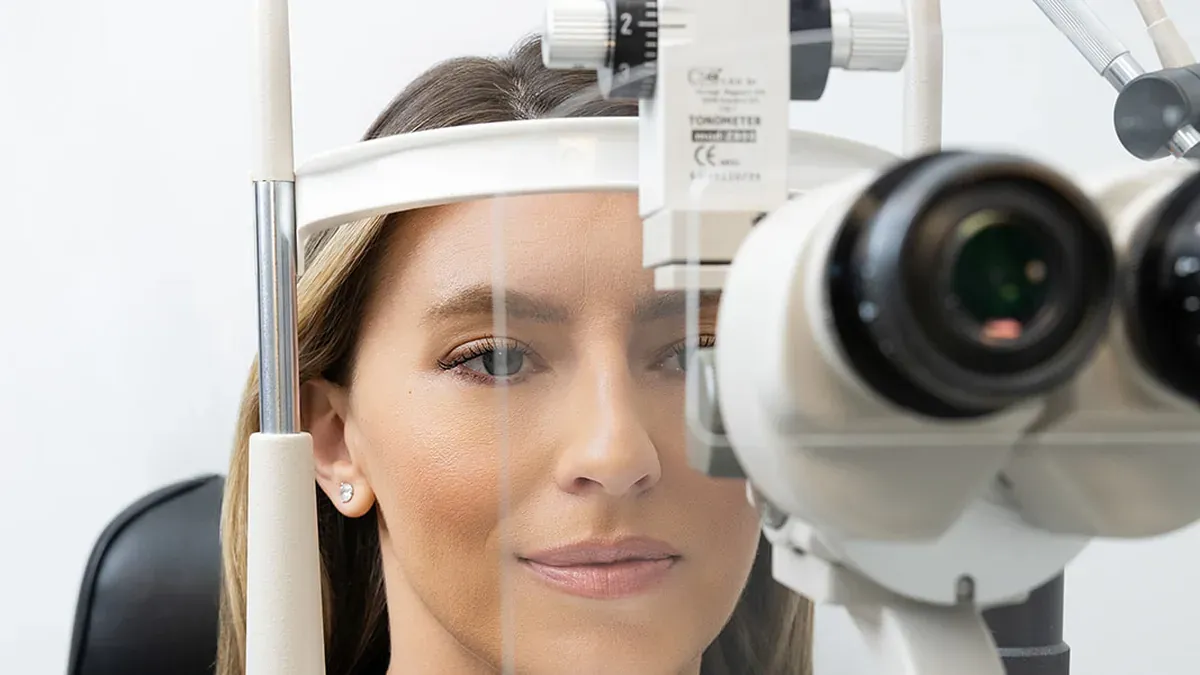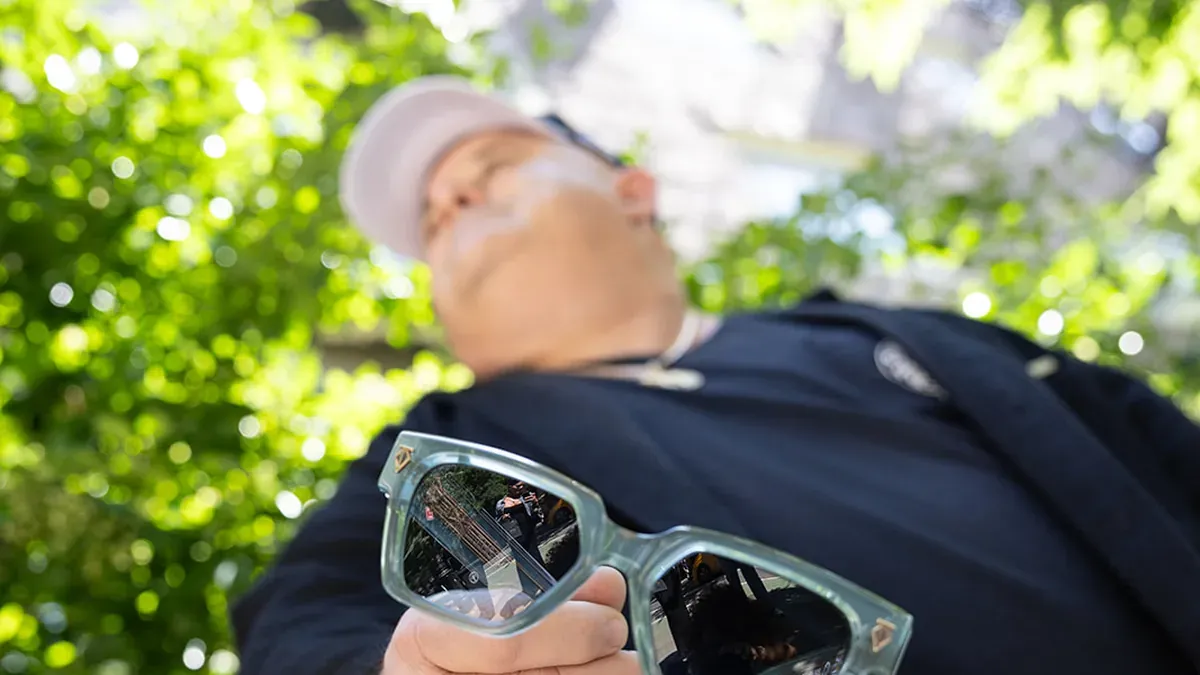
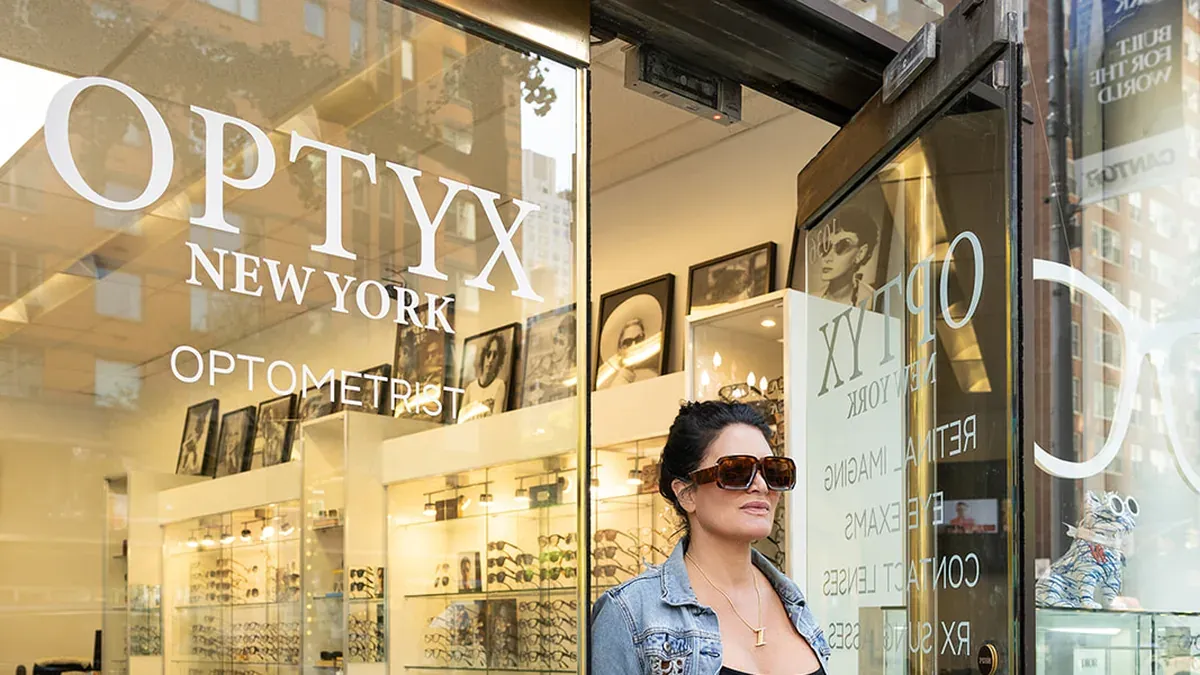
When comparing an optical store vs online for glasses, the real difference shows up not at checkout but when you put them on. Online retailers process a lens order. They cannot fit one. Prescription glasses fitting depends on face-specific measurements a selfie and a ruler cannot reliably capture. A certified optician measures each eye independently, adjusts the frame to your specific face, and checks whether your prescription has changed before the lab cuts a single lens.
At a Glance: Optical Store vs Online

| What You Need | In-Store Optical | Online Retailer |
|---|---|---|
| Prescription verified on-site | Yes | No |
| Monocular pupillary distance | Yes | Self-reported |
| Eyeglass frame adjustment | Yes | Not included |
| Custom progressive lenses | Yes | Limited accuracy |
| Luxury frames in store | Yes | Unauthorized sellers |
| Vision insurance | Check with your local OPTYX location | Often no |
| Optometrist on-site | Yes | No |
Is It Better to Buy Glasses Online or In Store?

For most prescriptions, an optical store produces a more accurate result. Online eyewear is practical for a simple single-vision prescription in a frame you already own and know fits well. Outside that narrow case, tradeoffs accumulate quickly.
A certified optician measures monocular pupillary distances, or monocular PDs, for each eye separately. Your left and right pupils are rarely equidistant from the center of your nose, and online orders ask for a single averaged number. Two millimeters off changes everything. When the optical center of the lens shifts away from your pupil, the result is blur and eye strain that gets blamed on the prescription instead of the fitting.
Vertex distance, the gap between the back of the lens and your cornea, matters for stronger prescriptions. Change that gap a few millimeters and the effective power changes. Pantoscopic tilt, the angle at which the frame leans toward your face, affects how the lens performs when you read.
In eyewear shopping NYC, these measurements are standard practice at an in-store optical. They are invisible in an online cart.
Professional optician benefits extend past the initial fitting. Frames drift over months. A bridge loosens. One temple sits lower than the other. OPTYX includes frame adjustments with every purchase, and an optician will realign the frame at no additional charge, as many times as needed.
Why Do Online Glasses Not Fit Properly?
Online glasses don't fit properly because fitting is not part of what you buy. The frame arrives at your door, never having been on your face in a controlled setting.
A frame that photographs well may gap at the temples, pinch the nose bridge, or press unevenly behind one ear. Eyeglass frame adjustment requires bench skills and proper tools. Acetate must be heated before it can bend safely. Metal must be reshaped without stressing the hinge. These are not tasks a customer can perform at home.
They are also not skills an online retailer ships with the package.
Online glasses wrong prescription is a separate and common complaint. When a self-measured PD is off by a few millimeters, the optical centers do not align with your pupils. Eye strain, persistent headaches, and distorted vision follow.
OPTYX regularly works with customers who ordered online and needed a full refraction and a new pair to correct it. Using FSA or vision insurance benefits on a new prescription pair can help offset that cost.
The problem multiplies for complex prescriptions. High myopia, strong astigmatism, and any lens with a prism component all amplify measurement errors. An in-store optician catches and corrects these at the fitting. An online order does not.
How Do Opticians Fit Progressive Lenses?

Custom progressive lenses are the clearest case for choosing an optical store vs online. Every measurement required depends on the physical frame sitting on your actual face.
A certified optician starts with separate monocular PD readings for each eye. They then mark the pupil height within the chosen frame, which sets where the reading, intermediate, and distance corridors will be positioned. Vertex distance and pantoscopic tilt get recorded and sent to the lab with the prescription.
When the geometry is right, progressives adapt within days. When it is off, the reading zone lands where the wearer cannot find it naturally, and adaptation never fully happens.
Most people who struggle with their first pair of progressives ordered them without a proper in-store fitting. They return convinced that progressive lenses simply do not work for them. After a professional refraction and a fitting with correct measurements, the same prescription in the right frame often adapts within a week.
Specialty lenses such as transition lenses follow the same logic. At OPTYX, every lens is digitally crafted for the individual wearer, with the optical center, base curve, and coatings matched to the specific frame and prescription together.
The Optical Store vs Online Difference That Price Comparisons Miss
Most optical store vs online comparisons focus on the frame price. They skip what happens when the order is wrong.
An online retailer processes whatever prescription numbers you enter. It does not check whether they fall within a normal range. It does not call the prescribing doctor when a value looks unusual.
A certified OPTYX optician does both. When a prescription differs significantly from the previous pair, the optician pauses and contacts the prescriber before cutting the lens. That step catches errors before they become a wearable problem.
OPTYX carries 20 designer brands in-store, including Cartier, DIOR, CELINE, LOEWE, FENDI, T HENRI, Lindberg, and Tom Ford. Many of these brands do not authorize third-party online sales.
Buying luxury frames in store means verified authenticity, the manufacturer's warranty, and guidance from a style icon trained to match frame shape to face structure and prescription. Choosing the right frame shape before your appointment focuses the fitting session on frames that will work.
OPTYX has been framing New Yorkers since 1971 across Manhattan, Long Island, the North Fork, the Hamptons, and Westchester. Optometrists at every location use technologies such as Optos ultra-widefield retinal imaging, which captures up to 200 degrees of the retina in a single image and does not require dilation in most cases. An online order cannot include that.
Book Your Eye Exam
A well-fitted pair of glasses starts with a current prescription and a certified optician who can see your face. Book an Eye Exam at your nearest OPTYX location.