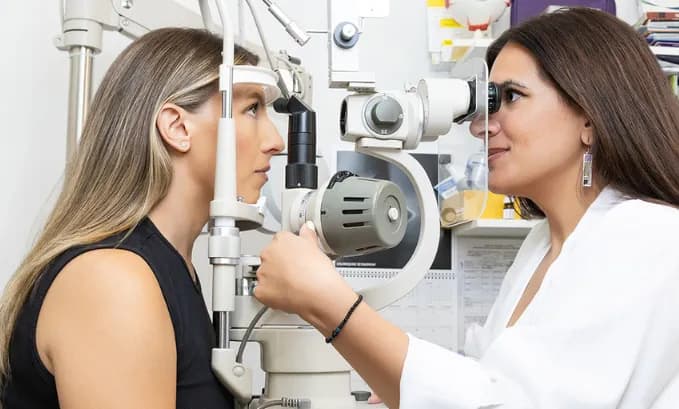

Progressive lenses are one of the most effective corrections for presbyopia, but the first few days of wearing them can feel disorienting. The optometrists at OPTYX NEW YORK reassure new wearers regularly: adjusting to progressive lenses is a normal process, and most people understand how to get used to progressive lenses within one to two weeks.
What you experience and how long it lasts depends on your prescription strength, your lens design, and how consistently you wear the lenses. Here is what the timeline looks like and what you can do to adapt faster.
Why Adjusting to Progressive Lenses Takes Time
Progressive lenses have three optical zones in a single lens: the upper zone for distance, the middle corridor for intermediate tasks, and the lower zone for reading. Your brain needs time to learn which zone covers each task.
Unlike single-vision lenses, where every part of the lens has the same power, progressives require you to aim your gaze at specific zones. The peripheral distortion many new wearers notice, a slight swim or bend at the lens edges, is a normal optical property and reduces significantly within the first week.
How Long to Get Used to Progressive Lenses
How long to get used to progressive lenses follows a consistent pattern for most wearers, even though the exact timeline varies.
Days 1 to 3. The first three days are the most disorienting. Peripheral distortion is strongest, distances may seem slightly off, and stairs or curbs can look uneven. Wear the lenses as much as possible rather than switching back to old glasses.
Days 4 to 7. Most people notice real improvement by day four or five. Distortion fades into the background and reading through the lower zone starts to feel natural. Tasks that felt awkward early on begin to work automatically.
Weeks 2 and 3. By week two, most wearers are no longer consciously thinking about where to look. Adjusting to progressive lenses has moved from deliberate effort to automatic habit. People with stronger prescriptions may still be fine-tuning during this period.
After three weeks. Persistent discomfort or significant blur past three weeks is worth raising with your optometrist. The lens fitting height, pupillary distance, or frame position may need a small correction.

How to Wear Progressive Lenses Correctly
How to wear progressive lenses comes down to learning to direct your gaze deliberately rather than simply moving your eyes.
For distance: Look straight ahead through the upper portion of the lens. This zone covers driving, watching television, and reading signs.
For intermediate: Look straight ahead through the center of the lens. This zone covers screen distance and tasks at roughly arm’s length.
For reading: Tilt your chin slightly down and lower your gaze. The reading zone is at the bottom of the lens. The habit to build is moving your chin, not lifting the page.
For peripheral vision: Turn your head rather than moving only your eyes. Looking through the side edges produces the most distortion. Moving your head keeps your gaze in the clearest part of the lens.
How Hard Is It to Get Used to Progressive Lenses?
How hard is it to get used to progressive lenses depends mainly on what you wore before and how strong your add power is.
First-time progressive wearers tend to have a harder initial adjustment than people switching from bifocals, because they are adapting both to a new prescription range and a new lens format at once. Stronger add powers, typical for people in their 50s and 60s, produce a narrower reading corridor and more pronounced peripheral distortion. Premium progressive lens designs with wider corridors reduce both noticeably compared to standard designs.
Tips for Adjusting to Progressive Lenses Faster
These habits consistently help new wearers figure out how to get used to progressive lenses more quickly.
- Wear the new lenses full time from day one. Alternating with old glasses slows adaptation significantly because your brain cannot fully commit to the new visual pattern.
- Turn your head toward what you are looking at rather than shifting only your eyes. This keeps your gaze in the clearest part of each zone and reduces edge distortion.
- Lower your chin to read rather than lifting the page. Most adaptation problems with close reading come from incorrect gaze angle, not the prescription itself.
- Accept that stairs and curbs will look slightly different for a few days. This resolves quickly and is not a sign of a fitting problem.
For a detailed overview of progressive lens types and correction ranges, the OPTYX NEW YORK guide to progressive reading glasses covers the distinctions across prescription types.
When Adjusting to Progressive Lenses Is Not Going as Expected
Most adjustment issues resolve on their own. A few specific signs warrant a follow-up.
Persistent headaches after the first week often point to a lens fitting height issue. A lens that sits too high or too low relative to your pupil forces your eyes to strain to find the correct zone.
Nausea or dizziness that does not improve after day three may indicate a pupillary distance measurement error, which is one of the most common fitting problems and quick to correct. Blur in one eye but not the other typically points to a prescription issue rather than a fitting one.

Book Your Progressive Lens Fitting at OPTYX NEW YORK
How to get used to progressive lenses becomes significantly easier when the lens is fitted correctly the first time, with accurate pupillary distance, fitting height, and frame alignment tailored to your prescription.
OPTYX NEW YORK has 14 locations across Manhattan, Long Island, the North Fork, the Hamptons, and Westchester. Book an eye exam and get a progressive lens fitting from an OPTYX NEW YORK optometrist.
Frequently Asked Questions
How long does it take to get used to progressive lenses?
Typically one to two weeks. The first few days are the most disorienting. By week two, most wearers are using the lenses automatically without active concentration.
How hard is it to get used to progressive lenses?
It depends on your prescription and what you wore before. First-time wearers and people with stronger add powers have longer adjustments. Premium wide-corridor designs reduce adaptation time compared to standard progressives.
What is the correct way to wear progressive lenses?
Look through the upper zone for distance, the center for intermediate tasks, and the lower zone for reading. Turning your head rather than moving only your eyes keeps your gaze in the clearest part of each zone and reduces peripheral distortion.
What speeds up adjusting to progressive lenses?
Adjusting goes faster when you wear the lenses full time from day one. Alternating with old glasses significantly slows the process. Learning the chin-down reading angle and turning your head rather than looking through the lens edges are the two habits that make the biggest difference.
When should I contact my optometrist during the adjustment period?
Contact your OPTYX New York optometrist if headaches, significant blur, or dizziness persist past the first week. Most issues that do not resolve on their own are fitting corrections, such as frame height or pupillary distance adjustments, that are straightforward to fix at a short follow-up visit.