
Astigmatism is one of the most common vision conditions, yet many people assume it is a permanent limitation rather than something treatable. The optometrists at OPTYX NEW YORK address this regularly: can astigmatism be corrected? In most cases, yes, through several well-established options that suit different prescriptions, lifestyles, and goals.
Here is what each correction method involves and how to determine which is right for your prescription.
What Is Astigmatism and How Can It Be Corrected?
What is astigmatism and how can it be corrected? Astigmatism occurs when the cornea or lens has an irregular curvature, more oval than spherical, so light entering the eye focuses at multiple points rather than a single point on the retina. The result is blurred or distorted vision at multiple distances, often described as seeing ghosting or doubling around letters and edges.
The correction approach depends on the type and degree of astigmatism. Refractive astigmatism, the most common type, responds well to glasses, contact lenses, and laser surgery. Irregular astigmatism from corneal scarring or keratoconus may require more specialized lens fitting or surgical management.
Can Astigmatism Be Corrected with Glasses?
Yes. Glasses are the most straightforward correction for astigmatism. Cylindrical or toric lens elements in the prescription offset the irregular corneal curvature, redirecting light to a single focal point on the retina. Can astigmatism be corrected with glasses at any prescription strength? Glasses handle both mild and high astigmatism reliably, which is why they remain the most common correction across all age groups.
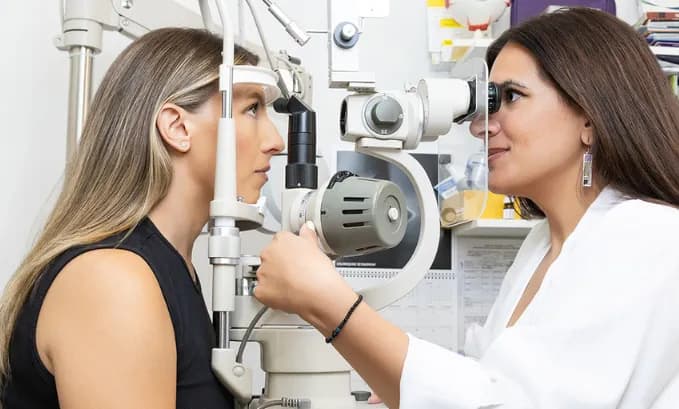
The prescription includes sphere (SPH), cylinder (CYL), and axis values. The CYL value describes the degree of astigmatism and the axis describes its orientation. OPTYX NEW YORK optometrists measure all three precisely using objective and subjective refraction as part of a standard eye exam.

Can Astigmatism Be Corrected with Contact Lenses?
Soft toric contact lenses correct astigmatism using different powers in different meridians of the lens, with a stabilization feature that keeps the lens aligned to match the corneal axis. They are appropriate for most mild to moderate astigmatism prescriptions and are available in daily, biweekly, and monthly modalities.
For higher or irregular astigmatism, rigid gas-permeable lenses or scleral lenses often provide sharper vision than soft torics because the rigid surface effectively replaces the irregular corneal shape with a smooth optical surface. An OPTYX NEW YORK optometrist can assess which lens type suits your corneal topography and astigmatism severity.
For context on how over-the-counter options compare, the OPTYX NEW YORK guide to reading glasses and astigmatism explains why standard readers fall short for most astigmatism prescriptions.
Can an Astigmatism Be Corrected with Laser Surgery?
Yes. LASIK, PRK, and LASEK reshape the corneal tissue using a laser to correct the irregular curvature at the source, eliminating the need for glasses or contacts for most patients. Can an astigmatism be corrected fully with LASIK? In most cases yes, typically up to around 6.0 diopters of cylinder. Higher degrees may be partially correctable, with residual correction needed for the remainder. A pre-surgical evaluation that includes corneal mapping and thickness measurement determines candidacy.
Can Astigmatism Be Corrected with Cataract Surgery?
Can astigmatism be corrected with cataract surgery? Yes. Toric intraocular lenses (IOLs) placed during cataract surgery correct astigmatism at the same time the cloudy natural lens is removed. This addresses both conditions in a single procedure and can significantly reduce post-surgical dependence on glasses for distance vision.
Limbal relaxing incisions, small curved cuts made at the corneal periphery during cataract surgery, can also reduce mild astigmatism where a toric IOL is not indicated. Discussing astigmatism correction goals before surgery allows the surgical team to plan the best IOL choice.
Can Astigmatism Be Corrected Naturally?
Can astigmatism be corrected naturally without lenses or surgery? No. Astigmatism reflects the physical shape of the cornea or lens, which cannot be changed through exercises, nutrition, or non-optical approaches. Claims that eye exercises reshape the cornea are not supported by clinical evidence.
Mild astigmatism in children sometimes shifts as the eye develops through adolescence. This is a natural refractive change during development, not a correction, and most children whose astigmatism shifts still benefit from optical correction throughout that period to prevent amblyopia.
How Can Astigmatism Be Corrected for Children and Adults?
How can astigmatism be corrected in children? Glasses are the standard first approach: effective at all ages, easily adjusted as the prescription changes, and the safest option for young eyes that are still developing. Contact lenses are typically introduced after age 12 to 13, depending on the child’s readiness for lens handling and hygiene.
For adults, all options are available. Adults over 45 managing both astigmatism and presbyopia often benefit most from progressive lenses or multifocal toric contacts, which correct both conditions in a single optical solution without needing separate pairs.

Book an Eye Exam at OPTYX NEW YORK
If you are asking whether can an astigmatism be corrected in your specific case, the answer starts with a precise refraction and corneal assessment. OPTYX NEW YORK optometrists measure astigmatism accurately and walk through every correction option suited to your prescription and lifestyle.
OPTYX NEW YORK has 14 locations across Manhattan, Long Island, the North Fork, the Hamptons, and Westchester. Book an eye exam and find out exactly how your astigmatism can be corrected.
Frequently Asked Questions
Can astigmatism be corrected?
Yes. The most common correction options are prescription glasses with cylindrical lenses, toric contact lenses, and laser surgery such as LASIK or PRK. For people undergoing cataract surgery, toric IOLs correct astigmatism and cataracts simultaneously. The right option depends on prescription strength, corneal health, and lifestyle.
What is astigmatism and how can it be corrected?
Astigmatism is an irregular curvature of the cornea or lens that causes light to focus at multiple points. It is corrected optically by adding a cylindrical element to glasses or toric contact lenses that offsets the irregular curvature, or surgically by reshaping the corneal tissue to eliminate the irregularity at the source.
Can astigmatism be corrected naturally?
No. The corneal shape cannot be changed through exercises or natural methods. Mild astigmatism in children may shift during normal eye development, but this is a developmental change and not a correction. Glasses, contact lenses, or surgery remain the only effective approaches.
Can astigmatism be corrected with cataract surgery?
Yes. Toric IOLs placed during cataract surgery correct both the cataract and the astigmatism in a single procedure. This is the most practical approach for patients who already need cataract surgery and want to reduce post-surgical dependence on glasses for distance correction.