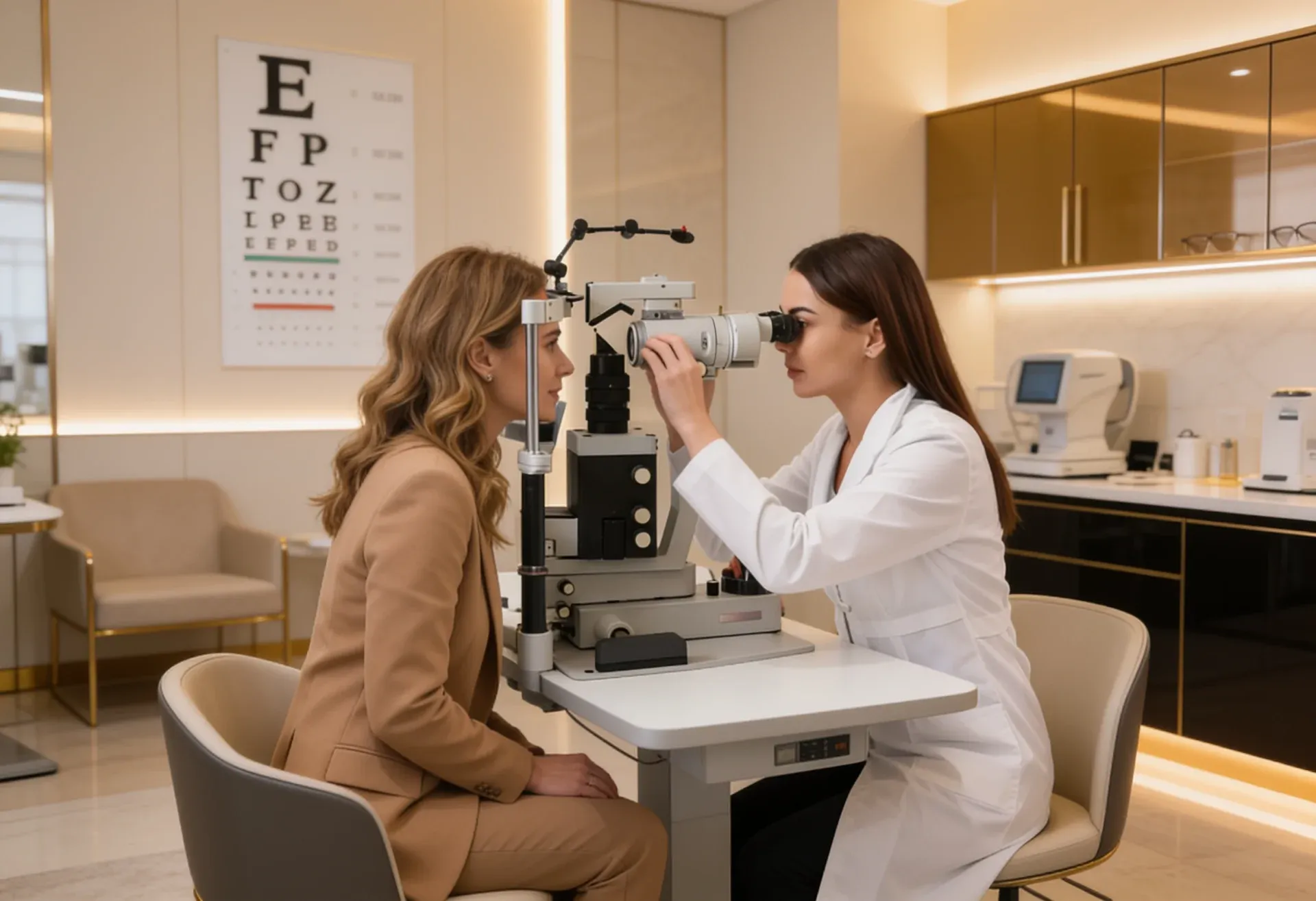

Blurry vision that comes and goes, clears briefly after blinking, and worsens through the day is a classic presentation of dry eye. The optometrists at OPTYX NEW YORK identify this pattern regularly: people arrive thinking their prescription has changed, and the actual cause is an unstable tear film producing inconsistent focus rather than a prescription shift.
Can dry eye cause blurry vision? Yes, and it is more common than most people realize. Here is how it works and what actually resolves it.
How Dry Eye Produces Blurry Vision
The tear film coating the front surface of your eye is the first optical surface that light hits before reaching the lens and retina. For vision to be sharp, that film needs to be smooth and stable. When dry eye disrupts the tear film, light entering the eye scatters rather than focusing cleanly, producing blur.
This is why dry eye blur is typically inconsistent: the tear film breaks down over several seconds after a blink, vision becomes blurry, you blink again, the film briefly restores, and vision clears momentarily. That cycle of intermittent blurring and clearing is the clearest sign that the tear film rather than the prescription is the source.
Can Dry Eye Cause Blurry Vision That Persists All Day?
Can dry eye cause blurry vision that does not clear with blinking? In more advanced dry eye, yes. When the tear film cannot maintain stability even briefly, blur becomes more constant rather than intermittent. The eye surface becomes irregularly shaped at a microscopic level, and even repeated blinking does not fully restore the optical clarity needed for sharp vision.
People in this stage of dry eye syndrome often also notice halos or starbursts around lights at night, increased sensitivity to glare, and difficulty reading fine text even with their correct prescription in place.
Can Dry Eye Syndrome Cause Blurry Vision in Both Eyes?
Can dry eye syndrome cause blurry vision affecting both eyes equally? Usually, yes. Dry eye is typically a systemic condition driven by tear production, evaporation rate, or meibomian gland function, and these factors generally affect both eyes similarly. Blur that is noticeably worse in one eye than the other is more likely to have a prescription or structural cause and warrants a focused examination of that eye.
If your blurry vision improves measurably with preservative-free lubricating drops in both eyes, can dry eye syndrome cause blurry vision in your case is answered clearly. If drops do not help at all, the blur more likely has a different cause worth investigating.

Can Dry Eye Drops Cause Blurry Vision?
Can dry eye drops cause blurry vision? Temporarily, yes. Gel-based drops and ointments, which are thicker and longer-lasting, can temporarily blur vision after application because the thicker formula takes a short time to distribute across the corneal surface. This blur typically clears within one to two minutes.
Can dry eye drops cause blurry vision with regular eye drops as well? Standard aqueous drops cause much less temporary blur than gels and it usually resolves within seconds. If blur persists for several minutes after standard drops, the drop formula may not be compatible with your tear chemistry, or the application method may need adjustment.
The type of drop that works best depends on the specific cause of your dry eye. An OPTYX NEW YORK optometrist can match you to the right formulation based on whether your dry eye is aqueous-deficient, evaporative, or a combination.
How Dry Eye Blur Differs from Prescription-Related Blur
Understanding whether blur comes from dry eye or a prescription change helps avoid unnecessary prescription updates. Dry eye blur has several distinguishing characteristics.
Dry eye blur fluctuates: it is worst in the afternoon, during screen use, or after time outdoors in wind, and it tends to be briefly clearer immediately after blinking. Prescription blur is consistent and does not change with blinking.
Dry eye blur responds to lubricating drops. If your vision noticeably sharpens after applying preservative-free drops, dry eye is the more likely explanation. Prescription blur does not respond to drops.
Dry eye blur is often accompanied by other symptoms: burning, grittiness, light sensitivity, and redness. Prescription blur appears in isolation without those accompanying eye surface symptoms.
Other Causes of Fluctuating Blurry Vision
Not all fluctuating blur is caused by dry eye. Other conditions that produce similar patterns include contact lens deposits, early cataracts affecting certain lighting conditions, and blood sugar fluctuations in people with diabetes. A comprehensive eye exam rules these in or out alongside dry eye assessment.
For dry eye that develops alongside hormonal changes, the OPTYX NEW YORK article on dry eyes and menopause covers one of the most common systemic triggers.
How OPTYX NEW YORK Treats Dry Eye Blurry Vision
Treating the blur means treating the dry eye, not updating the prescription. OPTYX NEW YORK optometrists assess tear film stability, blink rate, meibomian gland function, and corneal surface quality to identify the specific type of dry eye producing your symptoms.
A comprehensive eye exam at OPTYX NEW YORK includes anterior segment and tear film evaluation as standard components. Treatment approaches range from preservative-free drops and lid hygiene protocols to in-office procedures that restore meibomian gland function, depending on the severity and type of dry eye identified.
Book an Eye Exam at OPTYX NEW YORK
If your vision blurs intermittently, clears with blinking, and worsens through the day, a dry eye assessment is the right starting point. Can dry eye cause blurry vision in your case is a question our optometrists answer with a targeted evaluation, not a prescription change.
OPTYX NEW YORK has 14 locations across Manhattan, Long Island, the North Fork, the Hamptons, and Westchester. Book an eye exam and get clarity on what is actually behind your blur.
Frequently Asked Questions
Can astigmatism get worse over time?
Yes. Astigmatism can change at multiple life stages: during childhood development, in adults over 40 as presbyopia begins, and in people with conditions like keratoconus that progressively alter corneal shape. Annual eye exams catch these shifts before they affect daily vision.
Can astigmatism get worse suddenly?
Yes, though sudden changes are less common than gradual progression. Rapid worsening over days or weeks warrants a prompt eye exam rather than waiting for a routine appointment, as it can indicate keratoconus progression or a corneal change that benefits from early intervention.
Can astigmatism get worse with age?
Yes. Gradual changes in corneal curvature and lens flexibility through the 40s, 50s, and beyond can shift both the degree and axis of astigmatism. Many adults first notice their astigmatism changing when their reading correction needs updating at the same time.
Can your astigmatism get worse after wearing glasses?
Wearing glasses does not cause astigmatism to worsen. Glasses correct the irregular curvature optically but do not change the underlying corneal shape. If your prescription feels less effective over time, the astigmatism has shifted independently of the glasses, not because of them.