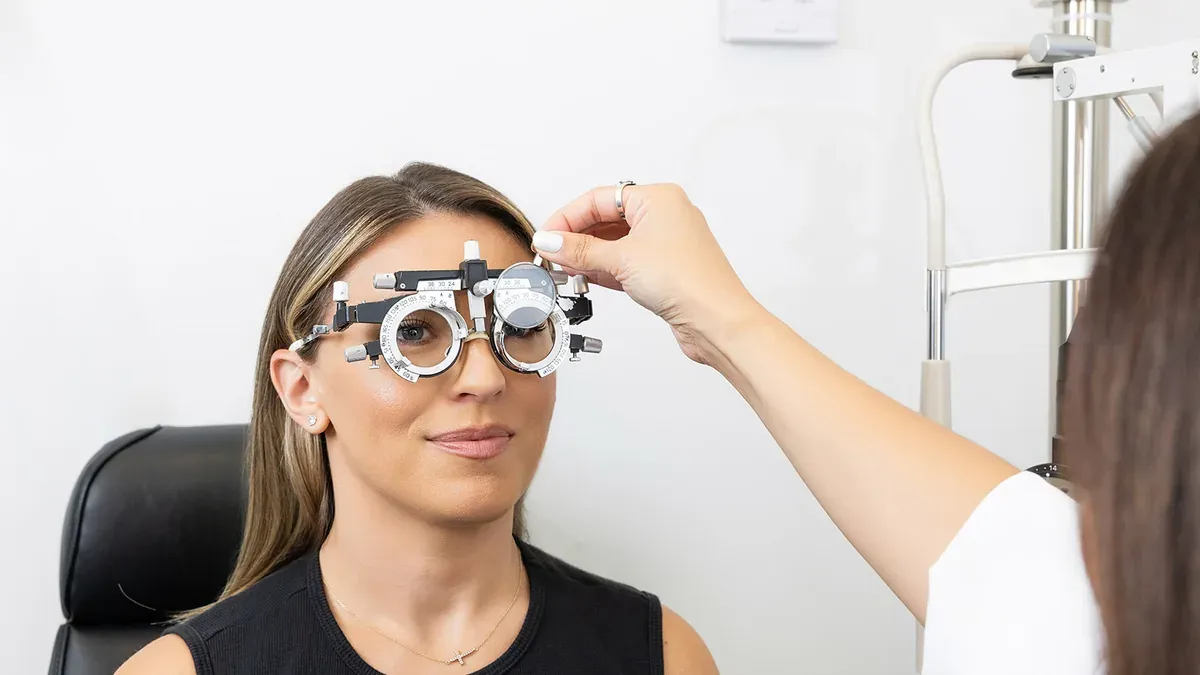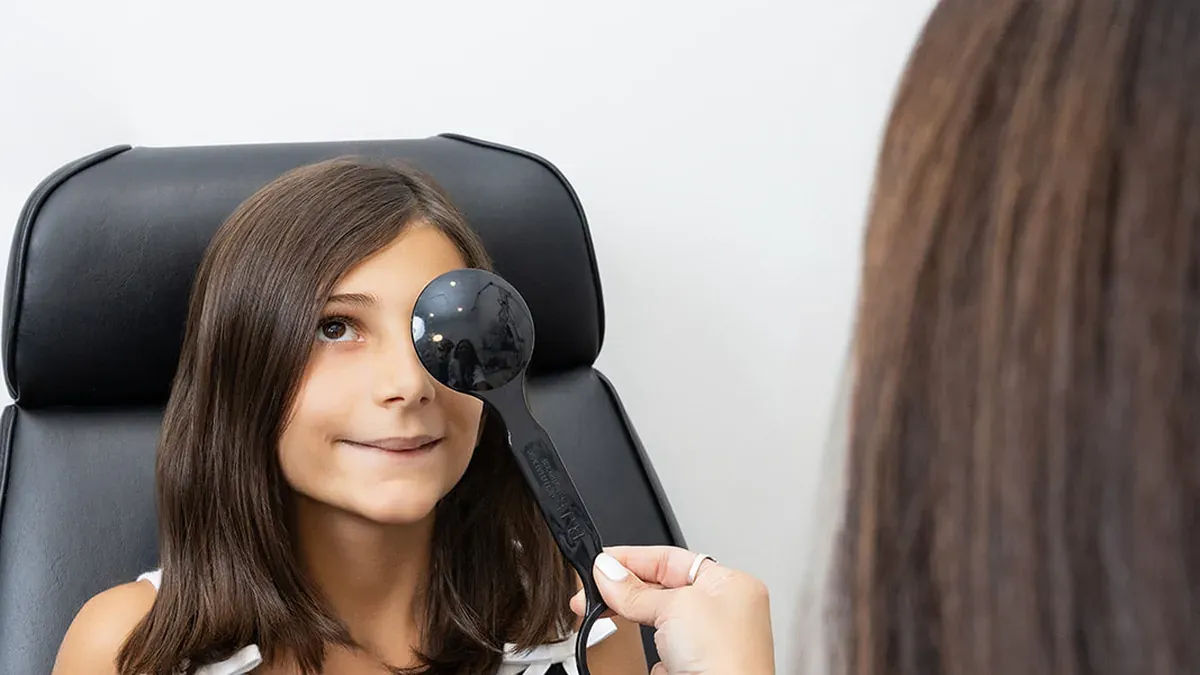
New York State does not run vision screenings at DMV offices. A DMV eye exam NYC is completed at a licensed optometrist's or ophthalmologist's office, where the provider documents your results on an official New York State vision form and submits it directly to the DMV. The minimum standard is 20/40 visual acuity in the better eye, with or without corrective lenses. That applies to first-time applicants and renewals alike. Book a vision screening for drivers at an OPTYX location and have your completed vision form handled the same day.
New York DMV Vision Requirements at a Glance
The New York DMV vision requirements for a standard Class D license come down to a short list. Here is what matters before your appointment:
- Minimum visual acuity: 20/40 in the better eye, measured with or without correction.
- Corrective lenses accepted: Glasses and contact lenses both qualify. If you need them to reach 20/40, you still pass.
- License restriction: When corrective lenses are required, the DMV notes this on your license. You must wear them every time you drive.
- Who performs the test: A licensed optometrist or ophthalmologist, not a DMV staff member. DMV offices no longer administer the test in-office.
- When it is required: Both new license applications and license renewals require a completed and signed vision form from a licensed provider.
If you wear glasses or contacts, bring them to your appointment. If your prescription is more than a year old, refresh it before the screening.
What Does a DMV Eye Exam Include?

The DMV eye exam NYC centers on the Snellen chart, the familiar grid of letters that decreases in size with each row. Your provider asks you to read the chart aloud at the standard testing distance. The smallest row you can identify clearly determines your visual acuity score.
Beyond the chart, the provider checks for conditions that could reduce driving safety:
- Refractive errors: Nearsightedness, farsightedness, and astigmatism each reduce sharpness at the distances required for safe driving.
- Cataracts: Clouding of the lens creates hazy or blurred vision that worsens at night and in low light.
- Glaucoma: This condition can quietly reduce peripheral awareness over time if left unmanaged.
- Amblyopia: Reduced acuity in one eye, sometimes called lazy eye, that a standard chart reading can detect.
- Strabismus: Eye misalignment that affects depth perception at road distances.
Any condition the optometrist believes could affect driving safety is documented on the vision form sent to the DMV. This is not an automatic denial. The DMV reviews each report and may request additional documentation before deciding.
If you already know you have one of these conditions, seeing your optometrist before the DMV screening is the practical first step. A full eye health evaluation at OPTYX New York covers all of them so nothing appears unexpectedly on test day.
What Vision Do You Need to Pass the New York DMV Eye Test?

The New York DMV requires 20/40 visual acuity in the better eye. Perfect 20/20 vision is not the target. Drivers with 20/20, 20/30, or 20/40 vision all meet the standard.
Vision worse than 20/40 in the better eye triggers a referral to a specialist for a detailed evaluation. That is not a permanent bar. After the specialist's report is reviewed, the DMV makes a final determination.
Corrected vision counts in full. If you reach 20/40 only with glasses or contacts, you pass. The 20/40 vision driving standard applies whether your acuity is natural or corrected, and your license will carry a corrective lens restriction. If your vision tests borderline 20/40, ask your optometrist to measure your corrected acuity before scheduling the DMV screening. An updated prescription often closes that gap without any further steps.
Can an Optometrist Sign My New York DMV Vision Form?

Yes. A licensed optometrist is the standard person for this job. The optometrist conducts the driver's license vision test, records the findings, and completes the official vision form on your behalf. You do not fill it out yourself. The signed document goes directly to the DMV as part of your application or renewal file.
If the optometrist finds a condition that may affect driving safety, the DMV could request a follow-up report from an ophthalmologist before clearing you. Most applicants with corrected or stable vision do not encounter that step. For a full breakdown of what the renewal process involves, see the license renewal eye exam guide.
Where to Get a DMV Vision Test in New York
Any licensed optometrist in New York State can perform the driver's license vision test and complete the required vision form. The right question before booking is whether that specific practice processes New York DMV vision forms and can provide a completed document the same day. Most dedicated optometry practices do. Confirming this before your visit is the only reliable approach.
Does Walgreens Do DMV Eye Exams?
Some Walgreens Vision Center locations employ licensed optometrists who can conduct the driver's license vision test and complete the required New York State vision form. Coverage varies by location. Call your nearest Walgreens Vision Center directly and ask whether they offer DMV vision form completion before scheduling an appointment. Not every pharmacy vision center provides this service.
Does CVS Do Vision Tests for the DMV?
CVS Optical locations vary in the same way. Some have licensed optometrists who can perform the test and process the paperwork; others do not. Calling ahead to confirm is the only reliable check. Any licensed optometrist in New York can legally complete the vision screening for drivers and sign the DMV form, so where you go comes down to which provider processes the paperwork during the same visit.
What If You Don't Pass the Vision Test?
Failing the screening once does not close your application. The DMV refers you to a vision specialist for a full evaluation. After that report is submitted, you can address the underlying cause and retake the screening.
The most common fix is an updated eyeglass or contact lens prescription. If your vision is correctable to the 20/40 standard with prescription lenses, the DMV will generally clear you to drive with a corrective lens restriction. Most applicants in this situation resolve the issue in one additional appointment.
How to Pass Your DMV Eye Exam in NYC
Good preparation is straightforward. Bring your glasses or contacts to the appointment. If your prescription is older than a year, schedule a comprehensive vision check before your DMV date. That visit updates your prescription and catches any conditions before they appear on the DMV form.
Get adequate rest the night before. Fatigued eyes are less accurate when reading small letters from a distance. Avoid eye drops that cause dilation unless your doctor has prescribed them, since dilation temporarily reduces sharpness.
A simple self-check: print a Snellen chart and see whether you can read the 20/40 line clearly. If you cannot, book your optometrist appointment before your DMV date, not after.
OPTYX New York has locations across Manhattan, Long Island, the North Fork, the Hamptons, and Westchester. An OPTYX optometrist will update your prescription, evaluate your eye health, and complete the DMV vision form in a single visit. For a closer look at what an OPTYX eye exam covers, see the full exam guide before you book.
Book Your DMV Vision Exam
If you need your New York State vision form completed by a licensed optometrist, Book an Eye Exam at your nearest OPTYX location.