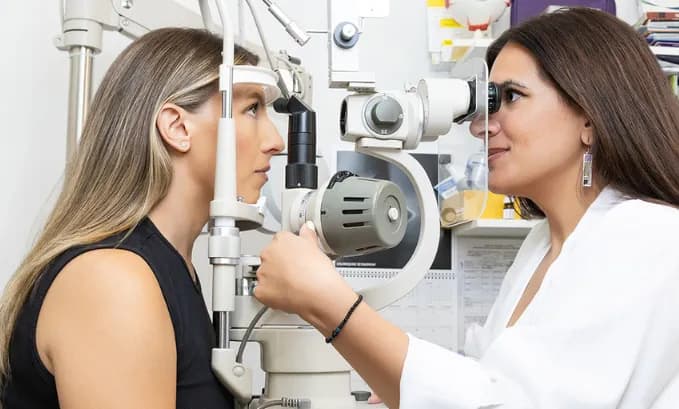

Diabetes affects the small blood vessels of the retina long before it affects how well you see. That is why this appointment exists: a diabetic eye exam catches damage at a stage where you feel nothing and would have no reason to book anything. Good vision is not evidence of a healthy retina. Here is what the exam involves, how often you need one, and why the dilation question matters more than people expect.
What Is a Diabetic Eye Exam?
A diabetic eye exam is a comprehensive examination with a specific focus on the retina and its blood vessels. Everything in a routine exam still happens — visual acuity, prescription, eye pressure — but the emphasis shifts to detecting the changes that raised blood sugar causes at the back of the eye.
Elevated glucose weakens the walls of the tiny retinal vessels: they leak, swell, close off, and in later stages the eye grows fragile new vessels to compensate. That process is diabetic retinopathy, and early on it is silent.
What Is a Diabetic Eye Exam Called?
You will see several names for the same appointment: a diabetic retinopathy exam, a dilated retinal exam, or simply an eye exam for diabetes. If a referral letter names one of these, it is asking for the examination described here.
How a Diabetic Eye Exam Differs From a Regular Eye Exam
A routine exam asks how well you see and whether your eyes are healthy. A diabetes eye exam asks a narrower question: has diabetes begun to damage your retina, and how far has it progressed. That means detailed retinal imaging and documentation, so this year’s retina can be compared with last year’s. The other difference is administrative: because it examines a medical condition, this exam usually falls under medical rather than vision cover.

What Does a Diabetic Eye Exam Consist Of?
For an eye exam for diabetic patients, expect:
- a review of your diabetes history, medications and most recent A1C
- visual acuity testing at distance and near
- a current prescription measurement
- tonometry to check intraocular pressure, since diabetes raises glaucoma risk
- examination of the front of the eye and lens for early cataract
- detailed retinal imaging and examination
The Diabetic Retinal Eye Exam
This is the core of it. The retina is examined for microaneurysms, haemorrhages, fatty deposits, closed vessels, swelling at the macula and new vessel growth. Macular oedema, meaning fluid in the part of the retina responsible for central vision, is a key finding that changes management, and it can be present while the chart still reads normal.
How Long Does a Diabetic Eye Exam Take?
Around 30 to 45 minutes at OPTYX. If dilating drops are used, add time for them to take effect and several hours of blurred, light-sensitive vision afterwards.
The Dilation Problem, and How We Avoid It
Dilation is why a lot of people quietly skip this appointment. Drops leave vision blurry and glare-sensitive for hours, which means not driving afterwards and writing off the day — a real obstacle if you are fitting screening around work.
At OPTYX we use Optos ultra-widefield retinal imaging, which captures the majority of the retina in a single image without drops. It produces a permanent record for year-on-year comparison and removes the main practical barrier to getting screened at all. Our comparison of Optos imaging versus dilation explains how the two differ, and we cover exams without dilation in more detail. For diabetic screening specifically, how Optos improves retinopathy detection sets out what the technology sees.
Some findings still warrant dilation for a closer look. If that is the case, we tell you in advance so you can plan — our guide on driving after an eye exam is worth reading first.
Signs of Diabetes in an Eye Exam
The signs of diabetes in eye exam findings appear in a predictable order: tiny vessel bulges, dot haemorrhages, lipid deposits, swelling and closed vessels, then new vessel growth in proliferative disease. We also look for glaucoma and cataract, both of which arrive earlier and progress faster in people with diabetes — see our guide to diabetes and glaucoma.
Fluctuating blood sugar also shifts your prescription temporarily, which is why a reading taken during a period of poor control may not hold.
Can an Eye Exam Detect Diabetes?
Sometimes, yes. Retinopathy is occasionally the first sign of undiagnosed type 2 diabetes, and an optometrist who spots characteristic retinal changes in someone with no diagnosis will refer them straight for blood testing. An eye exam is not a diabetes test, but the retina is the only place in the body where blood vessels can be examined directly, and that makes it unusually informative.
How Often Do You Need an Eye Exam for Diabetes?
Annually, regardless of how well you see. Type 1 usually means starting within five years of diagnosis; type 2 means an exam at diagnosis, since changes may already be present. Pregnancy warrants closer monitoring.
If early retinopathy is found, the interval shortens — often to every three to six months, depending on the stage and how well your blood sugar is controlled. The benefits of a diabetic eye exam come almost entirely from this regularity: early detection combined with treatment dramatically reduces the risk of serious vision loss, while the same disease caught late is far harder to manage.
Diabetic Eye Exam: Optometrist or Ophthalmologist?
The diabetic eye exam optometrist or ophthalmologist question comes up constantly, and the answer is straightforward. Annual screening is performed by an optometrist. That is what the appointment is for: detecting and monitoring change, and documenting the retina over time.
If treatment becomes necessary — laser, injections or surgery for advanced retinopathy or macular oedema — that is a retinal specialist’s work, and we refer you with your imaging. Most people with diabetes never need that referral, which is precisely the point of screening annually.
How Much Does a Diabetic Eye Exam Cost, and Is It Covered?
Here is the part that catches people out. Because this exam investigates a medical condition, it generally falls under your medical insurance rather than your vision plan. Many patients assume they have no cover because their vision benefit is used up for the year, then discover the exam was covered all along.
Medicare covers annual diabetic eye exams for people with diabetes. How much does a diabetic eye exam cost without cover depends on the imaging involved, so ask when you book — we check your benefits in advance. Our insurance information sets out what we work with.
How to Get the Most From Your Appointment
Bring a list of your medications, your most recent A1C figure and a note of any changes in your diabetes management. That context changes how findings are interpreted.
Afterwards, ask three questions: whether any retinopathy or macular swelling was found, how this year compares with last, and when you should return. Request a written summary to pass to your primary care provider or endocrinologist — they use it to shape your treatment plan, and that loop is one of the more useful things this appointment produces.
Book a Diabetic Eye Exam at OPTYX in New York
If it has been more than a year, or you have never had a dilated or widefield retinal exam since your diagnosis, this is the appointment to make. Searching for a diabetic eye exam near me will return plenty of results; what matters is widefield imaging, records you can compare annually, and an optometrist who communicates with the rest of your care team.
If you are looking for a diabetes eye exam near me, our optometrists screen patients across every OPTYX boutique, from the Upper East Side through Long Island to the Hamptons. Book a comprehensive eye exam, find your nearest OPTYX location, or explore everything we offer at OPTYX New York.

Frequently Asked Questions
What is the difference between a diabetic eye exam and a regular eye exam? A regular exam checks how well you see and general eye health. A diabetic exam adds detailed retinal imaging and documentation specifically to detect vessel damage, and is usually billed as medical rather than vision care.
What are the signs that diabetes is affecting my eyes? Often none at all in the early stages, which is the reason for annual screening. Later signs include blurred or fluctuating vision, floaters, dark patches and difficulty seeing at night. Any sudden change needs attention immediately.
Do I get a free eye exam if I am diabetic? Frequently it is covered rather than free. Medical insurance generally covers diabetic eye exams, and Medicare covers an annual exam for people with diabetes. We confirm your benefits before the appointment.
Can I have a diabetic eye exam without having my eyes dilated? In most cases, yes. Optos ultra-widefield imaging captures the retina without drops. If a finding needs a dilated view, we explain why before proceeding.
How often should I have a diabetic eye exam? At least annually, even with perfect vision. More often — usually every three to six months — if retinopathy has already been detected.
Does good blood sugar control mean I can skip the exam? No. Good control slows retinopathy considerably but does not eliminate the risk, and the earliest changes produce no symptoms. The annual exam is what confirms your control is protecting your retina.