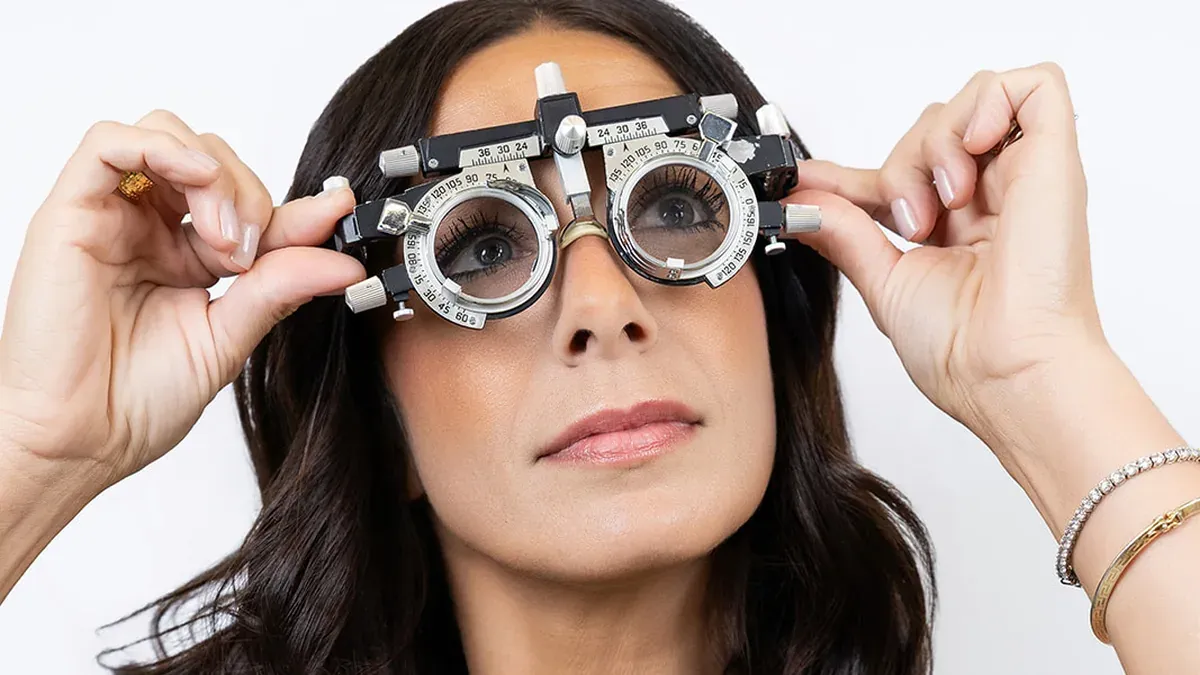
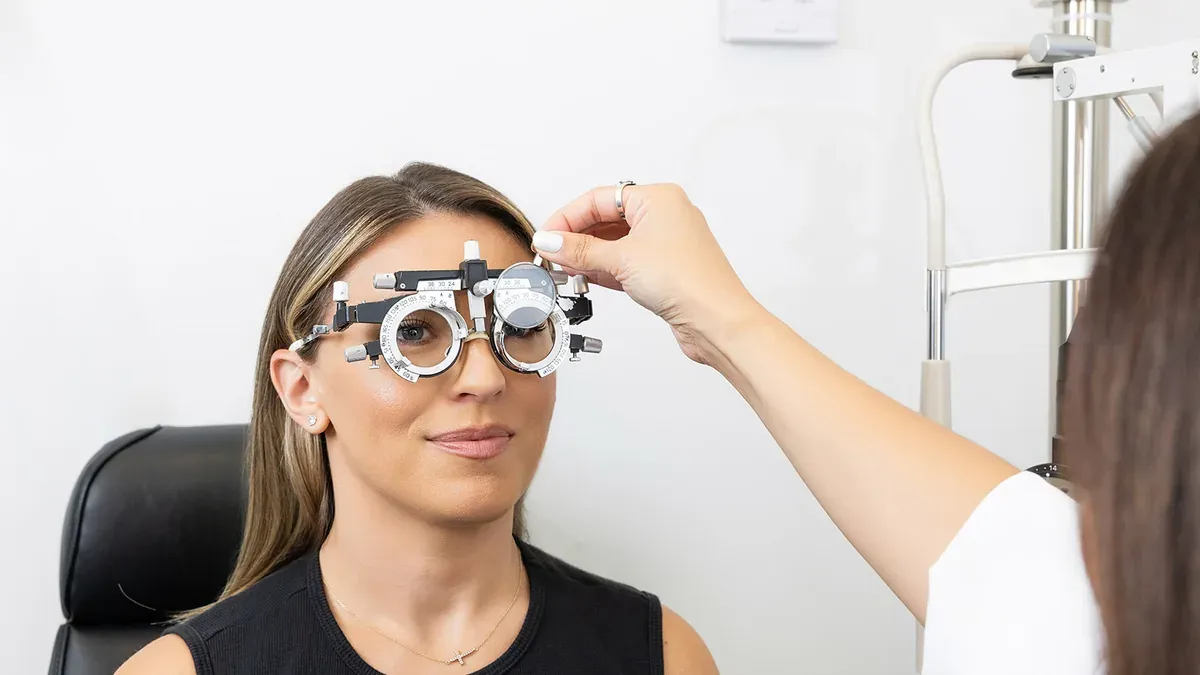
An accommodation eye test evaluates how well your eyes shift focus between near and distant objects, covering everything from reading a label to glancing at a screen across the room. The test measures the near point of accommodation, focus adjustment speed, and whether both eyes respond evenly. If you've noticed eye focusing difficulty or blur when switching between distances, an eye exam at OPTYX includes this assessment as a standard part of care.
What Is an Accommodation Eye Test?
Accommodation is the eye's ability to adjust its optical power so that objects at different distances stay in sharp focus. The lens inside the eye changes shape, driven by the ciliary muscles, to bring near text, a mid-range computer screen, or a distant street sign into clarity. This test measures how effectively this mechanism is working.
The test goes beyond checking whether you can read the smallest line on a chart at 20 feet. That standard measurement tells the clinician nothing about whether your eyes can sustain focus at close range or shift efficiently between distances. Only a dedicated accommodation test reveals how the near-vision system is actually performing.
During the test, an optometrist monitors your eyes as a small target moves closer or farther away. The NPA is the minimum distance at which your eye can still hold a clear image. A shorter near point indicates stronger accommodation; a receding near point is often the first measurable sign of age-related lens stiffening.
The accommodation eye test is not a single procedure. It describes a range of measurements that may also include a binocular alignment check to understand how both eyes work together under sustained near effort. This layered approach distinguishes it from basic distance-vision screening.
Who Needs an Accommodation Eye Test?

Eye focusing problems can appear at any age. Children with near vision difficulty may fall behind in the classroom without obvious signs of blur. Adults notice symptoms more gradually, usually as eyestrain at the end of a long workday or difficulty switching focus from a phone to a distant sign.
Signs that may point to an accommodation problem:
- Your vision blurs when shifting gaze between near and far distances.
- Headaches develop during or after reading, screen work, or close-up tasks.
- Eye strain or a pulling sensation builds behind the eyes after sustained near work.
- Text briefly appears double before coming back into focus.
- Concentration falters when reading continuously for more than a few minutes.
- Clear vision returns slowly after looking up from a close-up task.
After 40, the natural flexibility of the eye's lens begins to decline. This change is presbyopia, and presbyopia symptoms often become noticeable before a formal diagnosis. The person holds reading material at arm's length, needs brighter light, or finds that their distance glasses are no longer adequate for near tasks.
Presbyopia is widespread. A 2018 systematic review and meta-analysis estimated that 1.8 billion people globally had presbyopia in 2015, representing 25 percent of the world's population (Fricke et al., Ophthalmology, 2018). A 2024 review projected that rising population numbers will increase that count to 2.1 billion by 2030, even as the prevalence rate stabilizes at around 24 percent (Markoulli et al., Contact Lens & Anterior Eye, 2024).
Children and younger adults benefit from this exam too. Convergence insufficiency, a condition in which the eyes fail to point inward together at near distances, frequently coexists with accommodation problems. Symptoms overlap enough that both conditions are worth assessing at the same appointment.
How Is the Exam Performed?

The test is non-invasive. It takes roughly ten to fifteen minutes as part of a broader clinical appointment.
The optometrist begins with baseline distance-vision measurements and checks the current prescription. These findings give context for the accommodation results that follow. The accommodation testing itself typically uses two or three distinct methods.
Push-up test. A small printed target, usually a line of letters or a fine-detail pattern, starts beyond your comfortable reading distance and moves slowly toward your eyes. You indicate when the target first blurs, and the distance at that point is recorded as your near point of accommodation.
Minus-lens test. You focus on a fixed near target while the clinician places increasingly strong minus lenses in front of your eye. The lens strength at which the image blurs is converted to an accommodation value, offering a cross-check on the push-up result and reducing examiner variability.
Dynamic accommodation and binocular vision assessment. The clinician checks the speed and consistency of focus shifts between near and far targets, then verifies that both eyes are responding symmetrically. A significant difference between the two eyes, even when the near point appears normal, can produce fatigue and intermittent blur.
A phoropter or an accommodative ruler is typically used to quantify these measurements. For a broader look at how each diagnostic instrument fits into a clinical appointment, the testing process is explained at every stage.
No eye drops are required for the accommodation measurement itself. If the clinician needs to examine the retina or check the optic nerve more closely, dilation or retinal imaging may be added, and that is handled as a separate step.
If the accommodation findings suggest convergence insufficiency or binocular imbalance, the clinician adds vergence testing and cover testing before discussing next steps.
What Conditions Does an Accommodation Test Diagnose?
This assessment identifies conditions that standard distance-vision screening routinely misses. Each condition responds differently to management, which is why pinpointing the specific diagnosis rather than simply prescribing reading glasses makes a material difference to the outcome.
Presbyopia. The NPA retreats gradually as the crystalline lens stiffens with age. Presbyopia symptoms include near vision difficulty, the need for more light when reading, and strain during sustained close-up work. It cannot be reversed, but it is well managed with corrective lenses. Near-vision lens options for presbyopia range from reading glasses to multifocal and progressive designs; the right choice depends on your prescription and how you use your vision each day.
Accommodative insufficiency. This condition describes reduced accommodation amplitude relative to what is expected for the patient's age. Distance vision is often entirely normal. The core complaint is eye focusing difficulty at near distances, alongside headaches and eyestrain during reading or screen-based tasks. In school-age children, it can be mistaken for attention problems.
Accommodative infacility. The patient can achieve near focus, but transitions between distances are slow or unreliable. This shows up as a visual lag when quickly shifting from a smartphone to a road sign. Standard static vision tests do not detect it; a dynamic accommodation test is required.
Convergence insufficiency. The eyes struggle to maintain inward alignment when focused at near distances, producing reading fatigue, suppression of one eye's image, or intermittent double vision. Convergence insufficiency and accommodative insufficiency often appear together because the two systems share neurological pathways. A proper binocular vision assessment is needed to separate them and guide treatment.
Binocular imbalance. A large difference in accommodation amplitude between the right and left eye may indicate amblyopia, unequal refractive error, or a neurological cause that warrants further investigation.
What Do Accommodation Eye Test Results Mean?

Results are compared against normative values for the patient's age. The near point of accommodation retreats predictably as the lens stiffens: a result significantly farther from the eye than the norm for that age group is clinically meaningful, even if the patient has not yet noticed a problem.
What different results suggest:
- When the near point falls within the expected range for age, accommodation is functioning normally and persistent symptoms are likely driven by another cause, such as dry eye or refractive error.
- A near point farther than expected for the patient's age indicates reduced amplitude; the clinician will consider corrective lenses or vision therapy depending on severity and lifestyle demands.
- A significant difference between the right and left eye warrants further investigation for amblyopia, unequal refractive error, or a neurological cause.
- A normal near point with slow or inconsistent facility suggests accommodative infacility, for which targeted vision therapy is often the recommended next step.
After the accommodation eye test, your optometrist explains the findings directly and suggests a path forward. This may be an updated prescription, reading glasses, a referral for vision therapy, or a scheduled follow-up to monitor progression. The specific approach is determined after reviewing the full set of findings; no prescription path is one-size-fits-all.
OPTYX, with locations across Manhattan, Long Island, the North Fork, the Hamptons, and Westchester, incorporates the accommodation test into a structured eye examination that also covers retinal health, intraocular pressure, and additional binocular vision measures. A single visit can address multiple concerns at once.
Book an Eye Exam
If eye focusing problems, near vision difficulty, or persistent headaches are affecting your daily routine, Book an Eye Exam at OPTYX and have your accommodation assessed by an optometrist.