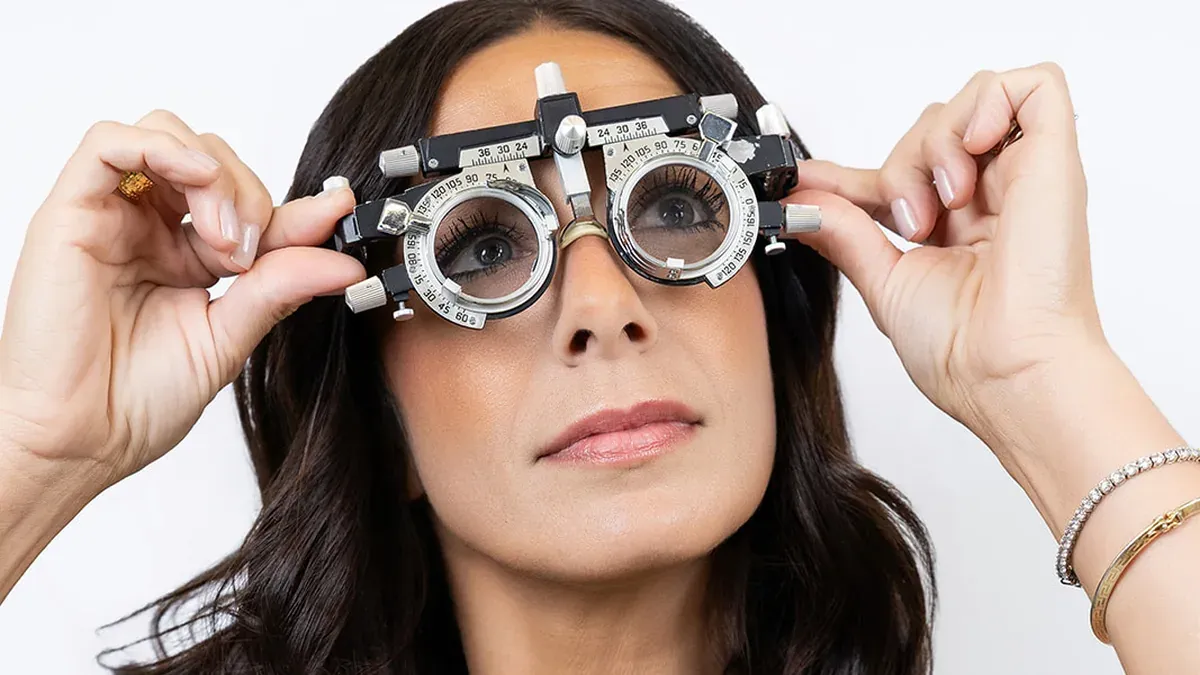
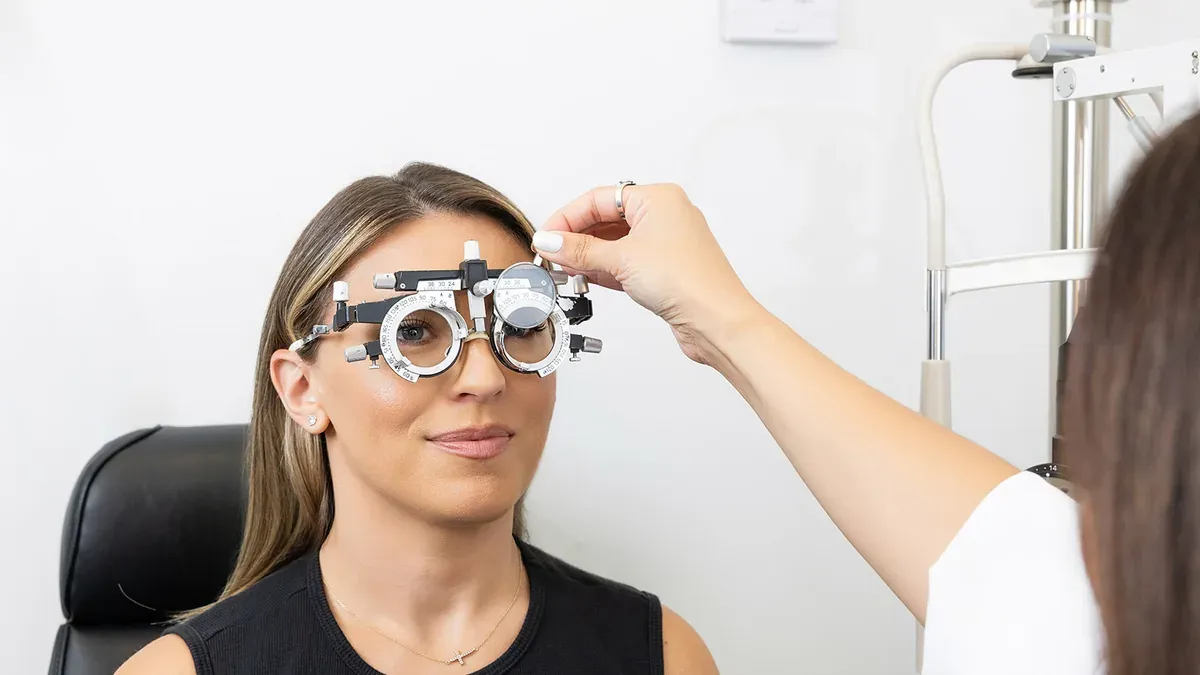
Most people leave the exam chair holding a prescription slip full of numbers they don't recognize. Getting your eye exam results explained is straightforward once you know what to look for. Every prescription lists a visual acuity score and a set of correction values per eye, using labels like OD (right eye) and OS (left eye) that follow the same universal format worldwide. See what each test involves in the OPTYX exam walkthrough.
Your Eye Exam Results Explained: Field by Field

A standard eyeglass prescription always contains the same six fields. Knowing how to read your eye prescription comes down to understanding each of these labels.
- OD identifies your right eye; OS identifies your left eye.
- Sphere (SPH) records the overall correction power: negative values correct nearsightedness, positive values correct farsightedness.
- Cylinder (CYL) records the amount of astigmatism correction your eye requires.
- Axis specifies the orientation of that astigmatism correction as a degree value between 0 and 180.
- Add records the extra near-vision power prescribed for bifocal or progressive lenses.
- PD records your pupillary distance in millimeters, used to center each lens correctly over your pupil.
This uniform format is what makes eye exam results explained at any clinic, not just the one where you tested.
What Does 20/20 Vision Mean on an Eye Exam?

20/20 vision means you can read the standard line on a Snellen chart from 20 feet, the same distance at which a person with typical unaided vision reads it. The first 20 is the testing distance; the second number is the distance at which a standard observer reads that same line. So 20/40 means you need to stand at 20 feet to see what a standard observer sees at 40 feet. Visual acuity decreases as the second number rises.
20/20 is the clinical benchmark, not the ceiling. Many people achieve 20/15 or even 20/10 with the right correction. Visual acuity and your refractive prescription measure different things: acuity records how clearly you currently see, the prescription records the optical power needed to reach standard clarity. At OPTYX, both appear on your exam summary together.
What Is a Normal Result for an Eye Exam?
A normal eye exam result covers two areas: functional vision and structural eye health. On the functional side, it means 20/20 visual acuity at distance and no significant refractive error. On the structural side, it means normal intraocular pressure, a clear optic nerve, and no early signs of glaucoma, macular degeneration, or diabetic retinopathy.
Normal does not mean perfect. Many people test at 20/15 or better. What matters is that your optometrist records a baseline for comparison at every future visit. The visual field exam is one additional test included in a full result, checking for blind spots or peripheral losses that a letter chart alone cannot detect. A sudden change in vision, new floaters, or flashing lights should not wait for a scheduled appointment; those warrant same-day evaluation.
What Do the Numbers on My Eye Prescription Mean?

Your prescription organizes correction values into labeled fields: sphere for overall blur, cylinder and axis for astigmatism, add for near vision, and OD or OS to identify which eye each row applies to. Eye prescription numbers meaning can feel complex at first, but the layout is consistent across every optometrist and every country.
What Is OD and OS on an Eye Prescription?
OD stands for oculus dexter, Latin for right eye. OS stands for oculus sinister, Latin for left eye. Some prescriptions also include OU, meaning both eyes together. The OD OS prescription abbreviations are international standards: a prescription written in New York is readable by any optician anywhere in the world.
Sphere, Cylinder, and Axis Explained
The sphere value is the core of the prescription, written in diopters in 0.25-step increments. Negative values indicate myopia (nearsightedness). Nearsighted prescription numbers like -1.50, -3.00, or -5.75 appear frequently on adult prescriptions. Positive values indicate hyperopia (farsightedness).
Cylinder and axis always appear together. Cylinder records how much astigmatism correction your eye needs; axis records the angle, from 0 to 180 degrees, at which to apply it. No cylinder entry means no clinically significant astigmatism is present.
The add value becomes relevant around age 40, when presbyopia makes near focus harder. It is always a positive number, added on top of the distance prescription to power the near zone of a bifocal or progressive lens. The guide to what a refraction exam actually measures explains how the optometrist arrives at each of these values during testing.
Here is a sample prescription showing all fields together:
OD (Right Eye): Sphere -1.50 / Cylinder -1.00 / Axis 90 / Add +2.00
OS (Left Eye): Sphere -1.75 / Cylinder -0.75 / Axis 180 / Add +1.75
This example corrects both nearsightedness and astigmatism in each eye. The add value indicates progressive or bifocal lenses for near vision.
How Do I Know If My Eye Prescription Is Strong?
Sphere values beyond -4.00 or +4.00 diopters are generally considered strong, while anything beyond -6.00 or +6.00 is classified as high. The eye prescription scale runs from roughly -20.00 to +20.00 diopters, though most everyday prescriptions fall within -6.00 to +4.00. Here is a rough guide:
- Mild correction includes sphere values from -0.25 to -1.50, or the positive equivalent.
- Moderate correction falls between sphere values of -1.75 and -4.00.
- Strong correction means sphere beyond -4.00 or +4.00.
- High correction applies to sphere beyond -6.00 or +6.00, which often requires thinner, higher-index lens materials.
Cylinder values follow a similar informal scale. Astigmatism above 2.00 diopters is typically considered moderate to significant.
Numbers alone do not tell the full story. A -5.00 prescription that corrects your vision to 20/20 is clinically very different from a -5.00 that only achieves 20/40, which can point to an underlying issue worth investigating. The eye exam preparation checklist covers everything that helps your optometrist measure your true visual needs accurately before you receive your result.
Book an Eye Exam
If your prescription is overdue or you have questions about what any of your numbers mean, Book an Eye Exam at an OPTYX location near you.