
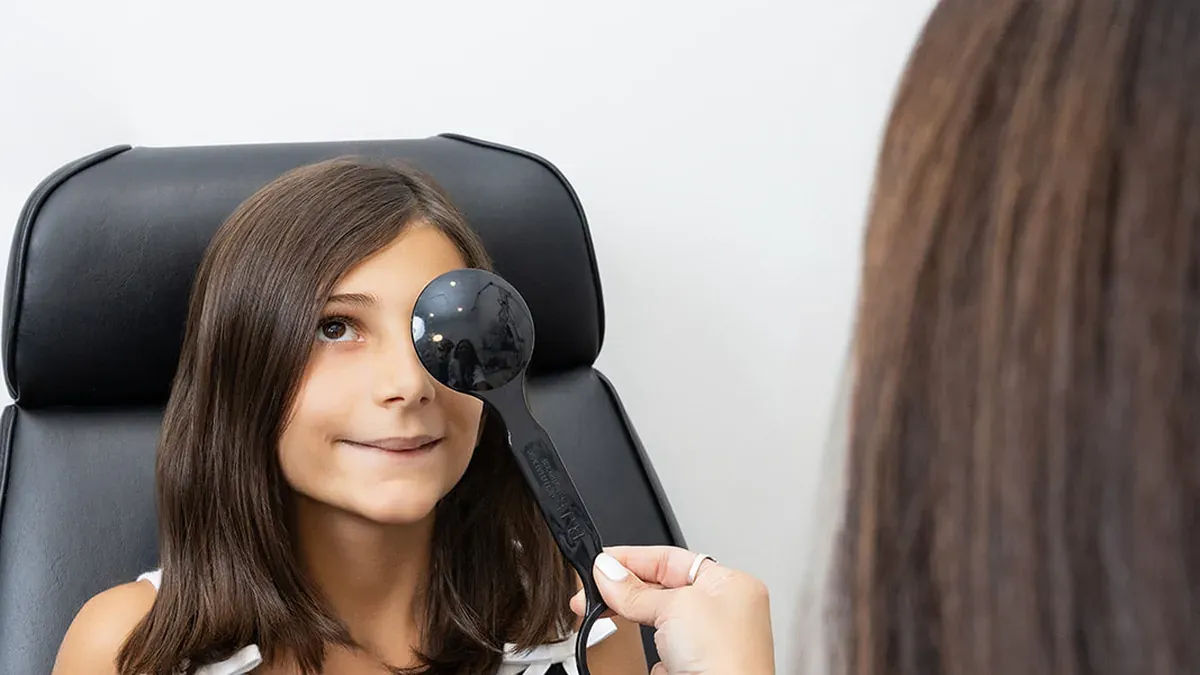
A refraction eye exam measures refractive error and generates the lens prescription that corrects your vision. Light travels through your eye and must land precisely on the retina. When it doesn't, vision blurs. At OPTYX New York, refraction is built into every full eye exam visit, and the resulting measurements determine every number on your glasses or contact lens prescription.
What Does a Refraction Test Measure?

Eye refraction measures how accurately your cornea and lens bend incoming light toward the retina. When that bending is off, the focal point misses the retina and vision blurs. The exam quantifies the specific correction needed to put light exactly where it belongs.
Four refractive errors the test identifies:
- Myopia (nearsightedness): light focuses in front of the retina, blurring distant objects while nearby ones stay clear.
- Hyperopia (farsightedness): light focuses behind the retina, creating difficulty with near vision and sometimes distance as well.
- Astigmatism: an irregular curvature of the cornea or lens scatters light at multiple points, blurring vision at all distances.
- Presbyopia: the eye's internal lens stiffens gradually with age, reducing the ability to focus on close objects.
The test measures each error type simultaneously to produce your prescription values. In clinical terms, the refraction definition is the measured amount and type of refractive error at a given point in time. Getting it right is what separates a prescription that works from one that only approximates your needs.
How the Refraction Eye Exam Works
A refraction eye exam typically uses two tools: a phoropter and an autorefractor. Most practices use both.
The phoropter is the large, lens-filled instrument your optometrist positions in front of your eyes. You look at a letter chart while the clinician adjusts lens power and asks which option makes the letters clearest. This back-and-forth process, called subjective refraction, relies entirely on your feedback. Clear communication here makes the result more accurate.
The autorefractor works without patient input. It sends a beam of infrared light through your eye, measures how the reflection returns, and estimates the needed correction automatically. This objective measurement gives the optometrist a starting point before the subjective phase begins, reducing overall chair time.
A 2022 review in Current Opinion in Ophthalmology found that clinical practice is moving toward automated and self-refraction instruments, which can provide faster measurements with lower variability than the traditional manual approach (Rodriguez-Lopez et al., 2022). Many of these technologies are already on the market.
OPTYX New York optometrists approach each exam using both objective and subjective methods to arrive at a reliable prescription across different lighting conditions and visual tasks.
Is a Refraction Test Included in a Comprehensive Eye Exam?
Yes. A refraction eye exam is always part of a comprehensive exam. Without a refraction test, there is no basis for calculating a glasses or contact lens prescription.
Refraction answers the prescription question. The rest of a comprehensive evaluation checks intraocular pressure, eye muscle alignment, peripheral vision, and the internal structures of the eye, including the optic nerve and retina.
Conditions such as early-stage glaucoma, macular changes, and diabetic eye disease produce no visible symptoms, yet they show up during clinical examination. That is why the difference between a vision screening and an eye exam matters: a school or workplace screening may catch gross acuity problems, but it does not capture the full clinical picture an optometrist builds over time.
What Is the Difference Between a Comprehensive Exam and a Refraction?

A refraction eye exam answers one focused question: what prescription does your eye need right now? A comprehensive eye exam answers whether your eyes are healthy.
A comprehensive exam typically includes:
- Visual acuity testing at near and far distances
- Intraocular pressure measurement as a marker for glaucoma
- Peripheral visual field assessment
- Evaluation of the anterior segment: cornea, lens, and anterior chamber
- Evaluation of the posterior segment: optic nerve, retina, and macula
- Refraction, as one component among several
The visual acuity test reads how clearly you see now. The refraction calculates what correction gets you there. The refraction numbers tell you what prescription to wear; everything else tells your optometrist whether the refractive error is the only issue or whether something else is developing.
A refraction-only visit is appropriate for updating a known prescription, but it does not catch the silent early findings that only a broader evaluation reveals. For the full breakdown of how exam types are categorized and billed, the guide on medical versus routine eye exams explains how the scope of each type differs.
How Long Does an Eye Exam With Refraction Take?

A standalone refraction eye exam takes five to ten minutes. When included in a full comprehensive exam, the appointment generally runs 45 minutes to an hour.
Bring your current glasses or contact lenses to every visit. Your optometrist uses your existing prescription as a starting point and measures what has changed, shortening the refraction phase. If the exam includes dilation to examine the retina, the full visit extends by 20 to 30 minutes, and near vision may stay temporarily blurry for a few hours afterward.
Does Vision Insurance Cover the Refraction Portion of an Eye Exam?
Most vision insurance plans cover the refraction test when it is part of an annual exam. Medical insurance, including Medicare Part B, does not: Medicare classifies routine refraction as a vision benefit rather than a medical service.
Patients with both medical and vision coverage typically have the refraction billed to the vision plan. Those with only medical insurance should expect a separate out-of-pocket charge for that portion of the visit. Check with your OPTYX location before your appointment to confirm what your plan covers.
If you want to understand what sphere, cylinder, and axis values mean, what your eye exam results tell you explains each number on your prescription in plain terms.
Why Accurate Refraction Matters Every Year
An outdated prescription is a consistent source of chronic headaches, eye fatigue, and difficulty concentrating. These symptoms develop gradually. People often adapt to them without realizing a corrected prescription would remove the problem entirely.
Refractive error changes year to year, sometimes quickly. Children with myopia may progress several steps during a single school year. Adults past 40 often notice gradual near-vision changes as presbyopia advances. An older patient who develops a sudden myopic shift may need evaluation for early lens changes that have nothing to do with the shape of the cornea.
Annual refraction gives your optometrist a repeated data point. Changes that look minor at one visit tell a meaningful story across three or four years of records. It is worth scheduling even when vision feels stable, because refractive error shifts before the discomfort becomes noticeable.
Patients who wear contact lenses have additional requirements beyond standard refraction. A contact lens exam includes lens fitting and corneal health checks that a glasses-only prescription visit does not require.
Book an Eye Exam
If your prescription is overdue or your vision feels off, Book an Eye Exam at OPTYX New York for a precise refraction alongside a full evaluation of your eye health.
Sources
- Rodriguez-Lopez V et al. (2022). Beyond traditional subjective refraction. Current Opinion in Ophthalmology. PubMed