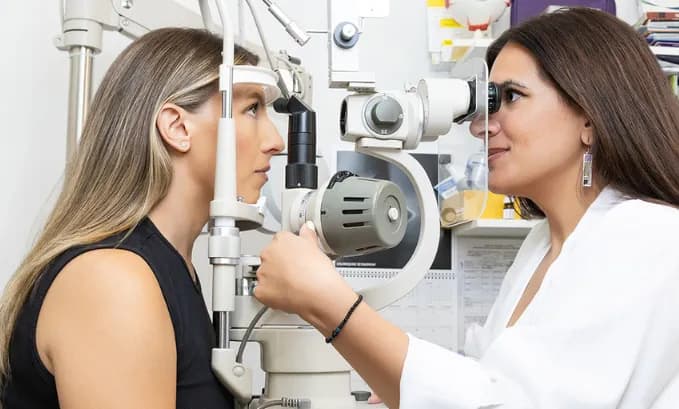

Maintaining best eyesight health depends critically on routine eye exams. These tests not only assess visual acuity but also offer insightful analysis of many facets of eye health, including refractive errors, ocular muscle function, and disease and condition screening. To grasp their visual condition and make wise decisions regarding the suitable corrective actions and treatment options, people must first understand the eye exam test results.
What happens during an eye exam?
An eye exam provides the assessment of your general eye condition and eyesight by an optometrist. Usually, an eye exam consists of the following basic procedures:
Measuring your range of vision clarity over an eye chart, the Visual Acuity Test Your visual acuity will be calculated by having you identify letters or symbols from a designated distance.
Measuring the way light bends through your eyes, the refraction exam finds your eyeglass prescription. The optometrist can find the lens power required to fix any refractive errors using a phoropter or digital refractor.
Occasionally the optometrist will dilate your pupils with eye drops. This lets you better study the interior workings of your eyes, including the optic nerve and retina.
Examining the rear of your eye—including the retina and blood vessels—the optometrist uses a specifically made ophthalmoscope. This clarifies among other eye conditions glaucoma, diabetic retinopathy, and macular degeneration.
The tonometry test gauges intraocular pressure—that is, the pressure inside your eyes. Usually using a tonometer, it aids in the diagnosis of glaucoma among other disorders.
An optometrist may also perform color vision tests, visual field tests, or corneal mapping depending on your particular requirements and any symptoms or concerns you could have.
These tests advise the optometrist in choosing the best course of action for treatment or corrections, help to identify any vision impairments or eye diseases, and give important information about your eye state. Frequent eye visits guarantee early identification of any possible problem and quick resolution of any current one.
Eye Test Result Explanation
Visual Acuity:
Your vision’s clarity and sharpness then is visual acuity. Usually, it is gauged using a Snellen chart, rows of different sized letters set on a gradient. The eye exam test results reveal themselves as a ratio, say 20/20 or 20/40. A visual acuity of 20/20 means that, from 20 feet, a person with normal vision can see what you can see. On the other hand, a visual acuity of 20/40 indicates that you have to be at 20 feet to see what a person with normal vision can see at 40 feet. Visual sharpness degrades more the smaller the second value in the ratio.

Refraction Errors:
Refraction errors, common vision problems, result from the eye’s shape allowing light to divert from straight focussing on the retina. Most typically observed in nature, refractive errors are found in:
The disorder known as myopia, or nearsightedness, causes distant objects to appear blurry while nearby objects are clearly seen. On your prescription, negative numbers, say -2.00 indicate nearsightedness—that is, the strength of the corrective lenses needed to improve distance vision.
Unlike nearsightedness, farsightedness—hyperopia—makes far-off objects sharper than close objects. Farsightedness on your prescription is shown by positive numbers—that example, +1.50—which denote the power of the corrective lenses required for clear close-up vision.
Astigmatism: Eye Test Result Explanation
Astigmatism is the result of an irregularly shaped cornea or lens that distorts or blurs vision at all distances. On your eye exam test results, two more numbers—known as axis and cylinder—often show this. The axis shows the astigmatism’s orientation; the cylinder shows the required astigmatism correction value.
An age-related disorder known as presbyopia influences close-up object focusing abilities. Usually apparent at the age of forty, it is rectified with bifocals or reading glasses.
Pupillary Distance (PD):
Pupillary distance, expressed in millimeters, is the distance between your pupils’ centers. Appropriately fitted eyeglasses depend on this dimension. Accurate PD guarantees that your lenses’ optical centers match your pupils, therefore improving visual clarity and lowering eyestrain. Either your optometrist will record your PD for your prescription or measure it during the eye test.
Knowing these eye exam test results findings will help you to better understand your visual requirements and enable the choice of suitable eyewear or corrective action to maximize your vision. Early identification and effective treatment of any possible visual issue or eye condition depend on regular eye exams.

Prescription Format: How To Read an Eye Exam Result
Understanding your vision correction needs depends on knowing how to read an eye test result. Let’s dissect the usual parts of an eye exam test results and discuss their meaning:
Sphere(SPH): The sphere value shows whether one is farsighted—indicated by a positive value—or nearsighted—indicated by a negative value. It shows the lens’s general power required to fix your eyesight.
CYLinder (CYL): For those with astigmatism—that is, when the cornea has an uneven shape—the cylinder value is important. Always associated with an axis value, this value indicates the necessary degree of astigmatism correction.
Axis: The astigmatism correction required’s orientation is specified by the axis value. Measuring in degrees, it falls between 0 and 180 to show the angle the astigmatism correction should be applied to the lens.
Add: The add value is applicable for individuals who require bifocals or progressive lenses to address near vision correction. It indicates the additional power required for clear near vision.
Here’s an example prescription to illustrate these values:
OD (Right Eye):
Sphere (SPH): -1.50
Cylinder (CYL): -1.00
Axis: 90
Add: +2.00
OS (Left Eye):
Sphere (SPH): -1.75
Cylinder (CYL): -0.75
Axis: 180
Add: +1.75
In simple terms, this eye exam test results indicate that the right eye requires correction for both nearsightedness (-1.50) and astigmatism (-1.00), with the astigmatism correction at a 90-degree axis. Additionally, bifocal or progressive lenses with a power of +2.00 are needed for near vision. The left eye has similar eye exam test results with slightly different values.
Understanding your eye exam test results empowers you to make informed decisions about your vision correction and collaborate effectively with your eye care professional.
Conclusion: Eye Exam Test Results
Your knowledge of the eye exam test results will determine whether you keep perfect eye health and choose wisely for your vision treatment. Knowing your prescription and test findings will enable you to be aggressive in maintaining and enhancing your eyesight all your life.
By means of frequent eye exam test results, identify and prevent probable eye disorders including diabetic retinopathy, macular degeneration, and cataracts. Changing prescriptions, considering surgery, and using corrective lenses ensures that the advice given following your eye exam test results guarantees appropriate treatment suited to your unique need:
At Optyx, our first priorities are your eye condition and provide customized treatment together with comprehensive eye tests. Plan your regular eye exams with us to ensure the longevity of your vision and to receive first-rate treatment from our trained staff. Take immediate control over your optical condition!